It’s the start of a new school year here in Blacksburg. The library, like the rest of campus, is seeing plenty of students, both new and seasoned. Our post this week is for those of you still learning your way AND those of you who think you know all the secrets. We’re taking a trip back in time and sharing some photographs of Blacksburg from about 1895-1925. As you’ll see, things have come a LONG way!
Before 1900, Main St. saw its fair share of horse traffic. This photograph was taken from the road, looking at the old Preston and Olin Building/then VPI machine shop.Far in the distance at the center of the frame is the VPI machine shop. This photograph was taken on Main St. looking west, possibly near the Post Office.C. 1900, the Post Office and Hack Depot shared a building on Main St., several blocks away from campus.If you stood smack in the middle of Main St., right past the College Ave. intersection (think: right in front of Moe’s–please don’t try it!) and looked up hill, this is what you’d see before 1900. No Main St. or Alumni Mall entrance to campus.Ellett’s Drugstore was on the corner of Main St. and College Ave., in the current Sharkey’s space.Blacksburg, c.1904. In those days, Main Street ended at College Ave. At the bottom center of the frame are a set of metal gates–essentially the entrance to campus! The brick building on the left is where you’ll see Sharkey’s today. The building on the right is the current Moe’s. And hey, at least VPI won the game!This image is actually the front of a postcard, sent in 1917, but taken before then. By then, the metal gates from the 1904 photograph were actually brick structures with a sign and Main St. was no longer a dead-end, but open to traffic!By 1930, some more familiar surroundings were build in Blacksburg. The 5-10-25 Cent store is at the current site of Moe’s. To the right of it, on College Ave., you can see The Lyric Theatre in current home.
Our historical photograph collection in Special Collections covers a wide variety of University and local history places and spaces. It can show you a lot about how Blacksburg and Virginia Tech have changed. And even if you can’t visit us, you can check out a large selection of images online:http://imagebase.lib.vt.edu/index.php. There’s plenty of history to discover!
While pulling materials for our Special Collections open house last week I came across this little gem.
From Ms2007-017 Natalie de Blois Architectural Collection. Note from de Blois’s father listing the number of women practicing architecture in 1941.
A handwritten note from architect Natalie de Bloiss father dated 1941. The note lists figures he pulled from a New York Times article about the status of women practicing architecture in the United States and in New York, in particular, during this period. As you may guess in 1941 that was not a very high number.
1944 saw de Bloiss graduation from Columbia Universitys architecture program and her first professional job with the firm Ketchum, Gina & Sharp. She relates in a 2004 interview with Detlef Mertins that she was fired nine months later after rebuffing the affections of a fellow architect at the firm. No matter. She quickly secured a job with the then-fledgling but soon-to-be powerhouse firm, Skidmore, Owings & Merrill (SOM).
Here she spent the majority of her professional career working closely with architect Gordon Bunshaft, earning notoriety within the architectural community as one of the top female architects in America. But that notoriety was often not formally recognized. Nathaniel Owings, one of the original founders of SOM, relates in his 1973 autobiography that de Bloiss mind and hands worked marvels in design and only she and God would ever know just how many great solutions, with the imprimatur of one of the male heroes of SOM, owed much more to her than was attributed by either SOM or the client.
de Blois is now recognized for her work on a number of influential SOM projects including: Lever House (NYC); Pepsi-Cola building (NYC); Union Carbide Corporation (NYC); Connecticut General Life Insurance (Hartford, CT); Lincoln Center (NYC); and the Hilton Hotel (Istanbul, Turkey).
After 30 years with SOM, she left to join the Houston firm of Neuhaus & Taylor as Senior Project Designer, and during the last thirteen years of her architecture career, she taught at the University of Texas at Austin, retiring in 1993. de Blois passed away of cancer earlier this year on July 22, 2013. She was 92 years old.
She had a fascinating career. If you think Joan and Peggy have it rough you should read her in-depth interview with Mertins mentioned above. But the thing I love most about this great collection is this tiny scrap of paper, a note from a father to a daughter.
******************
By the way if you missed our last open house dont fret we are holding them on the first Tuesday of each month this fall, through December.
I had originally planned to write a bit about some of the magazines edited in the early 1940s by recently departed Fred Pohl. At 19, he managed to talk his way into the editorship of two publications: Super Science Stories and Astonishing Stories. Pohl instituted the first SF book review columns of any substance in these magazines, and published early work from the Futurians, that notable circle of young New York SF fans and writers including notables such as Pohl himself, Asimov, James Blish, Hannes Bok, Damon Knight, and Judith Merril. This work bridged the gap between the SF pulps and the more sophisticated magazines of the 1950s and beyond (in which Pohl also figured heavily as a writer and editor).
When I pulled a few numbers, I ran across yet another cover stamped by a used magazine store. I used to see plenty of post-1950 SF magazines, and never noticed any of these stamps, but they do seem show up on our pulps somewhat frequently:
As far as the used magazine stores go, there seem to be very few left standing. I have never laid eyes on one; by the time I was looking for old SF it was in used book stores, the sort that carried mostly trade paperbacks in western, romance, crime, and horror (i.e. the usual pulpy suspects).
Newsstand. Omaha, Nebraska, 1938 (LoC American Memory Project)
My guess is that the used magazine stores probably started to fade out sometime in the 1950s, after the paperback (and the television) had begun to more fully displace periodicals as a vehicle for popular fiction. The fragility of the stock must have also been a limiting factor; the magazines were just not built to last. We can elevate these stamps into evidence of past patterns of popular readership. But the disappearance of a cheap outlet for a particular cultural product also makes me think about the need for nimble and active collecting, bringing to mind the great old quotation from Jeremy Belknap, founder of the Massachusetts Historical Society:
“There is nothing like having a good repository and keeping a good look out, not waiting at home for things to fall into the lap, but prowling about like a wolf for the prey.”
That is still the case for institutional collectors, whether you are hunting through an attic or a strip mall:
Gently Used Books, Douglassville, PA [http://newsnotblues.blogspot.com]
The first of four open house events at Special Collections will be held on Tuesday September 3rd from 5:00PM to 7:00PM. Other open houses will be held on the first Tuesday of each month this fall, through December.
If you’ve never taken the opportunity to explore the holdings of Special Collections—but perhaps you’ve never seen a first edition of James Joyce’s Ulysses, or always wondered about the relationship between cocktails and prohibition, or couldn’t believe that a 56 year old fellow from Wisconsin really did enlist in the Union Army in October 1861 . . . alongside his 12 year-old son—well, now would be a good time to start. We’ll have a representative sample of our holdings on display and staff members on hand who will be happy to answer your questions.
Selection of Civil War DiariesTwo works by Langston Hughes: A New Song (1938; signed) and Scottsboro Limited (1931)
This is just a sample of what you’ll find when you visit Special Collections. Please do drop in this Tuesday, September 3rd or, if you can’t make it then, visit us for one of our First Tuesday Open House events this fall. Whether to support an interest or provide assistance for a research project Special Collections is here to offer a wealth of assistance and materials. Come see us!
The Benjamin Franklin Butler Notebook contains a fiery diatribe against General Ulysses S. Grant. But did Butler actually write it?
The Suspect
Benjamin Franklin Butler (1838-1893) was one of the Civil War’s most controversial generals. Rising to the rank of major general in the Union Army largely through political appointment, Butler was castigated in the North for his military failures and reviled in the South for policies enacted while administering the wartime occupation of New Orleans.
The Evidence
The Benjamin Franklin Butler Notebook (Ms1990-060) arrived in Special Collections in 1990, as a donation from Elden E. Josh Billings, a collector of Civil War books and memorabilia. Containing approximately 125 pages, the notebook is devoted to a fiery attack, spanning several chapters, against Union leadership during the Civil War. Ulysses S. Grant is a favorite target of the writer, who charges the Army of the Potomacs commanding general with incompetence, recklessness, favoritism, and cowardice. The author supports his arguments with interspersed clippings from newspapers and reports. Divided into several chapters and heavily revised, the diatribe seems intended for publication.
The piece is unsigned and unfortunately incomplete, lacking several of the pages at the front. The only clue to authorship is a penciled note on the flyleaf:
“Manuscript book in hand of Gen. Benjam [sic] Franklin Butler, against General U. S. Grant, never published”The Investigation
Though the writer defends Butler’s reputation while attacking Grant’s, an examination of the text suggests that Butler did not write it. The writer refers to Butler in the third person but then later refers to himself in the first person. Elsewhere, the writer mentions that he broke his sword (i.e., resigned his commission) rather than wage war on women, children and property. Butler, however, resigned his commission only after the wars end. The writer also mentions that he has never seen Grant, a statement certainly not true of Butler. Moreover, the text does not match the tone in Butlers published writings; nor does the handwriting match examples of Butler’s penmanship found online.
Evidence points toward Gustave Paul Cluseret (1823-1900), a French soldier of fortune, politician, writer, and artist as the items creator. In his critique of Grant and others, the writer refers to editorial pieces that he had published in Cluseret’s newspaper, The New Nation. The French general had come to the United States soon after the wars outbreak but soon gained a reputation as a rabble-rouser and was placed under arrest on unspecified charges in early 1863. Cluseret resigned his commission shortly thereafter and later became editor of The New Nation. Like Cluseret, the author of this piece shows personal familiarity with European military history, and the tone of the piece matches Cluserets known belligerent and iconoclastic nature.
Typical of the writer’s anti-Grant tirade is a passage on this page, in which he charges Grant with negligence of duty: “Grant, as usual, did nothing and saw nothing. . , as he was more comfortable at his head-quarters. . . [H]e left his troops for pure Havanas and champaign [sic], the green tree and delicious reveries in a recumbant [sic] position. . .To confirm Cluseret as the writer, we hoped to find published copies of the editorials to which the writer refers. Unfortunately, but few issues of the newspaper have survived, and of those remaining, none contains an editorial specifically issued under Cluserets name. (It seems likely, however, that any unsigned editorials in the paper would have been written by the editor.)
The alternative, then, was to find examples of Cluserets handwriting. I contacted counterparts in repositories that hold letters written by Cluseret but found that the handwriting in the copies provided didn’t match that in the notebook. On the other hand, the four letters obtained also do not match, bearing at least three different and distinct handwriting styles. It seems possible that Cluseret, whose command of English was said by contemporaries to have been limited, relied on a series of private secretaries to express his thoughts.
The Verdict
Unfortunately, with the information we have, authorship of the piece cannot be definitively credited. And so, because it bears Benjamin Butler’s name and arrived here as such, the item continues to be cataloged as the Benjamin Franklin Butler Notebook until more evidence may someday come to hand.
In 2007, Special Collections at Virginia Tech was graciously gifted a copy of Isaac Newtons Opticks or a Treatise of the Reflections, Refractions, Inflections and Colours of Light.
Title Page from Opticks, or, A treatise of the reflections, refractions, inflections and colours of light by Sir Isaac Newton
Opticks was Newton’s second major book on physical science and was first published in English in 1704, with a scholarly Latin translation following in 1706. The book analyzes the fundamental nature of light by means of the refraction of light with prisms and lenses, the diffraction of light by closely spaced sheets of glass, and the behavior of color mixtures with spectral lights or pigment powders.
The publication of Opticks represented a major contribution to science, and was well received and hotly debated upon its release. Opticks is largely a record of experiments and the deductions made from them, covering a wide range of topics. In the book Newton sets forth in full his experiments, first reported to the Royal Academy of London in 1672 on dispersion, or the separation of light into a spectrum of its component colors. He demonstrates how the appearance of color arises from selective absorption, reflection, or transmission of the various component parts of the incident light.
The major significance of Newton’s work is that it overturned the dogma, attributed to Aristotle or Theophrastus and accepted by scholars in Newton’s time, that “pure” light (such as the light attributed to the Sun) is fundamentally white or colorless, and is altered into color by mixture with darkness caused by interactions with matter. Newton showed just the opposite was true: light is composed of different spectral hues, and all colors, including white, are formed by various mixtures of these hues.
Fold-out page with diagrams illustrating Newton’s experiments
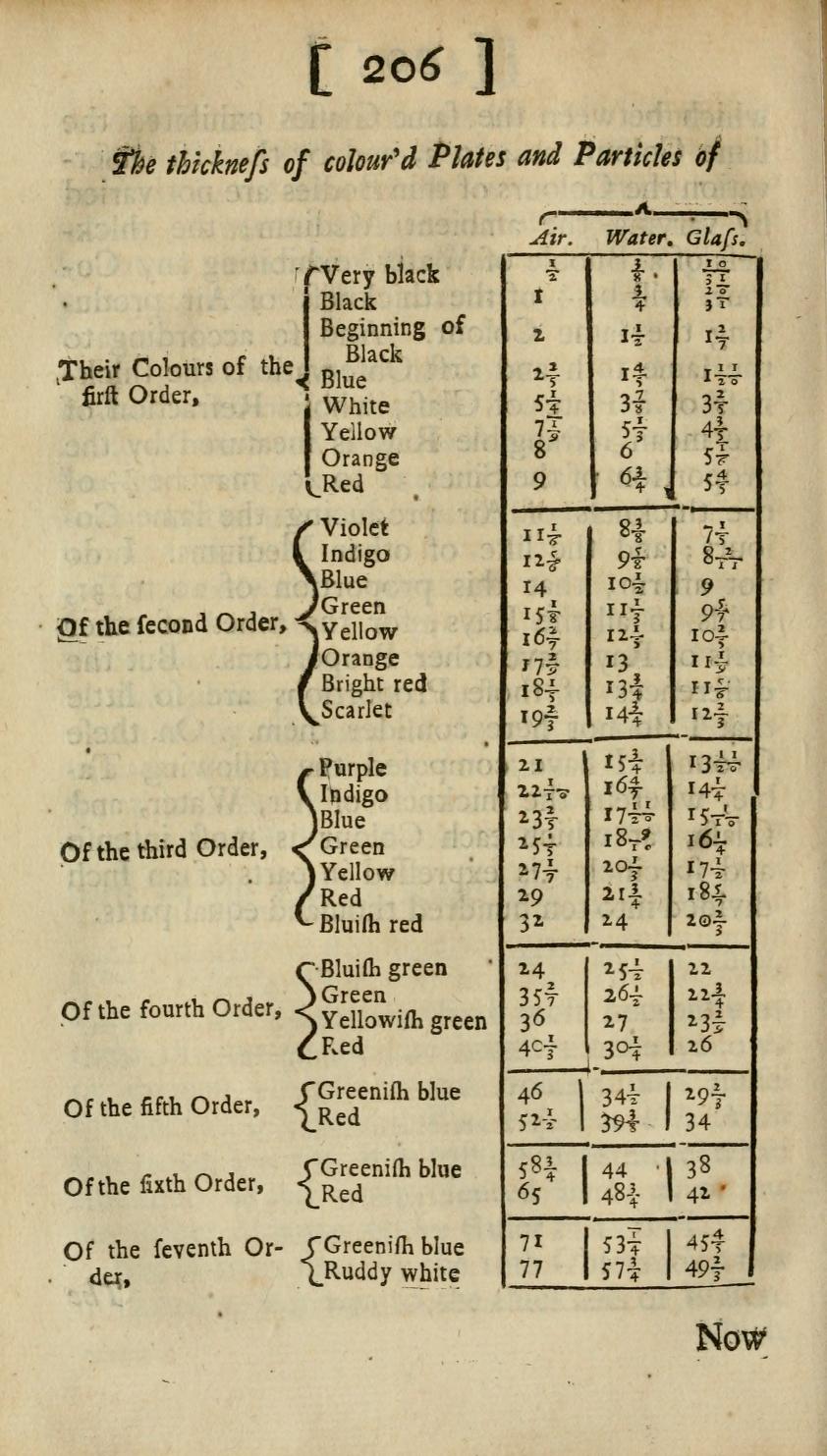
A chart containing results of Newton’s tests
Opening page to Part I of the text
The copy belonging to Special Collections is a 3rd edition of the text, printed in 1721 in London for William and John Innys and was the last edition produced during Newtons lifetime. This nearly 300 year old leather bound book is in excellent condition, even the fold-out pages containing diagrams of Newtons experiments.
The gift was designated by the donors in honor of Matthew Charles Ziegler, Class of 2003. Since it is not recommended that modern materials such as bookplates and their glue be attached to such extraordinary and rare books, this information is noted in the bibliographic record. What a great way to commemorate a Hokie!
Virginia Tech Special Collections may not be known for our literary collections, but we have our fair share of literary surprises among the stacks. And we constantly find new ones. We have a wonderful selection of British and American first editions on our shelves, including a first edition of James Joyce’sUlyssesanda signed Langston Hughes’A New Song. Although I am an archivist at heart, my background is in literature and the long 19th century of British writing. One day, perusing manuscript collections from the days before VT had a Special Collections department, I found a letter written by Victoria Cross. Her name may not sound familiar, but the letter says something about an author who was considered racy and bold in her own time.
July 20, 1909
Dear Mr. Morris
I am sending you an autograph copy of Life’s Shop window and I should be so glad if you will read it through carefully from beginning to end and form your own opinion on it. People who are jealous of me always howl at my writings the reproach that they are immoral From my own point of view I have never written a single immoral line in my life. I am immensely proud of my books and would read them aloud to a jury of Bishops with the greatest of pleasure any time.
It is most important for you to feel the same confidence as I do in them and to know personally the contents of one at least so that you can combat the rediculous [sic] statements made about me. I know how extremely busy you are but if you will make time to read it carefully, I know when you are in the U. S. and can speak with authority on my work, you will feel the time spend in reading it was not wasted.
With so many thanks for all the trouble you have taken for me already
Yours sincerely
Victoria Cross
Victoria Cross was one of several pseudonyms of Annie Sophie Cory (1868-1952), a British writer in the late 19th and early 20th century. She also wrote as Victoria Crosse, Vivian Cory, and V. C. Griffin.Cory was born in India and educated in England. She never married, and traveled extensively– two things that put her outside the normal expectations of her gender and place in society. Both are aspects of her life that influence her writing, likely leading to declarations of her “immorality” mentioned in the letter. And yet she, and a score of other late Victorian “New Women” writers helped to shape the next generation of women authors.
Despite the claims of their scandalous, exotic, or “immortal” nature, Cory’s works were well-read and popular in many circles. After all, how many readers are tempted by the novel that they are told isn’t appropriate reading?Life’s Shop-Window, the book she mentions in her letter, was first published in 1907.You can read itonlinethrough the Internet Archive. In 1914, it was even made into a movie! If you’re seeking a slightly shorter introduction to “Victoria Cross,” I recommend her first published short story,”Theodora: A Fragment” which appeared in The Yellow Book in 1895. Contemporary morals may be different, but you’ll still be in for a treat.
And as for us, well, we get to keep a little piece of that progressive, confident, “New Woman” history in our Special Collections.
Mardi Gras Parade, New Orleans, Louisiana (LOC) http://www.flickr.com/photos/library_of_congress/8385172346/
When I was a wee lass pondering my future I did what any bookish young person (pre-Google) would doI went to my local library. In this case, I went to my childhood library to interview the library director about careers in librarianship. This is the only tidbit I remember librarians love conferences.
Its true. Think about it for a moment. Librarians love information and learning new tricks of the trade and what better venue to do that in than an overly air-conditioned, poorly decorated hotel conference room in Indianapolis, Washington, D.C., or Anaheim.
Archivists also like their conferences and our big one is coming up in a few weeks. Yay, New Orleans in August! In honor of our soon to be host city I thought I would highlight some IAWA collections from the Crescent City.
One of the many institutions of higher learning in New Orleans is Tulane University. For 120 years (1886-2006) Newcomb College operated as a coordinate college of Tulane. Founded by Josephine Louise Newcombs desire to establish a college in memory of her daughter, Harriot Sophie, Newcomb College would in time flourish academically becoming by 1916 one of only seven southern schools to hold a standard college designation within the Southern Association of College Women. Two departments in particular garnered regional and even international admiration: the Department of Physical Education and the Newcomb Art School (1910-1945).
Jacobean Arm Chair, Fannie Magee Drawings, part of Ms2009-054 IAWA Small Collections.
Newcomb Studio, Fannie Magee Drawings, part of Ms2009-054 IAWA Small Collections.
Portrait of a Newcomb girl on a stool (1915), by Wanda Simmons, Newcomb College Drawings, part of Ms2009-054 IAWA Small Collections.
The Newcomb Art School offered an industrial art program featuring pottery, interior design, furniture making, and many other arts and crafts in an effort to educate women in the practical side of life, as well as, to provide employment opportunities for women when few existed. The IAWA has 16 original pencil drawings from students who attended the Newcomb Art School featuring drawings of furniture and interiors by Wanda Simmons and Fannie Magee.
Our next collection with a Big Easy connection is the Betty L. Moss Architectural Collection. Moss was an architect in New Orleans who opened her practice in the 1940s and continued until her death in 2007. A graduate of both Newcomb College and Tulane she was a proud New Orleans resident and an outspoken defender of building preservation and conservation. In October of 2005, a mere 2 months afterHurricane Katrina, she submitted designs for 3 + 4 bedroom prototype houses for the new New Orleans to city officials. These raised houses were designed to protect life and property and to fit the historic New Orleans lot sizes and aesthetic.
From Ms2008-071 Betty L. Moss Architectural Collection. Drawing of Moss’s proposed raised 3 bedroom prototype for Post Katrina New Orleans.
From Ms2008-071 Betty L. Moss Architectural Collection. Moss’s proposed integration of Harrah’s Casino into the exciting Rivergate structure.
Moss along with our third New Orleanian, Abbey Gorin, worked ardently to defend against the demolition of the Rivergate, a mid-20th century Expressionist structure that existed on Canal Street, where the main thoroughfare of the city meets the Mississippi River. The futuristic convention center designed by New Orleans architectural firm Nathaniel C. Curtis Jr. and Arthur Q. Davis lasted only 27 years before it was demolished in 1995 to make way for a Harrahs casino. Moss and Gorin wrote a six-minute film about the history and importance of the structure and it is present in Gorins collection.
Our conference hotel is just a mere 0.1 mile from Harrahs casino, and I would much rather see the undulating concrete roof line of the Rivergate, meant to mimic the Mississippi River, than the bright lights of Harrahs.
If anyone has any suggestions of what I should see and where I should eat in the City that Care Forgot please drop me a line in the comments section below.
8. [Crawford, William L.]: MARVEL TALES Volume 1, Number 2. Everett, PA: Fantasy Publications, 1934. 60pp. Original paper wrappers, stapled; top and bottom edges worn, corners bumped. Internally clean. Very good.
Marvel Tales was semi-professional editor William L. Crawford’s attempt to fill in the gap left during a brief, early Depression-era lull in the mass-market science fiction magazine marketplace. Crawford saw Marvel Tales as his own vehicle for publishing material too risky for editors at the helm of contemporary magazines such as Astounding Stories, Amazing Stories, and Wonder Stories. Serving simultaneously as publisher, editor, and typesetter, he produced five issues during 1934 and 1935, of which this is the second, notably featuring the first publication of Robert Howard’s short story “The Garden of Fear”. The present copy bears the yellow and green cover variant; the text does not include the printing errors found in the second, variant issue described by Miller and Contento. “Marvel Tales was a worthwhile and exciting experiment that could have had a significant impact on the development of SF had it succeeded . . . Crawford has been overlooked in the history of SF, but one day he will be accorded his place beside pioneers F. Orlin Tremaine and John W. Campbell, as an editor who tried to shape the future of SF” — Tymn. Nineteen copies located in OCLC. An attractive survival of 1930s SF fandom, and not common in the marketplace.
Edward Beyer’s Sketch of the Montgomery White Sulphur Springs resort, as planned in 1853.
Summer is here and that means it is time to think about vacationing! While most visitors to our region today tour historically significant sites and enjoy the many recreational activities available in the Blue Ridge Mountains, over a hundred years ago, the most popular attractions in the area were mineral spring resorts. These large and beautiful campuses advertised themselves as ideal for those desiring a change for the purpose of health, novelty, recreation, and to get rid of the wearing activities of business life.
The Yellow Sulphur Springs resort, located between Blacksburg and Christiansburg, commenced operation as a health spa in 1810. Similarly, the Montgomery White Sulphur Springs resort, in Ellett Valley, was incorporated by a group of local businessmen in 1855. Benefiting from the popular belief in the restorative powers of mineral waters, both resorts catered to a new leisure class seeking healthy and entertaining distractions. Offering such amenities as ballrooms, billiards, bowling alleys, gazebos, and sports fields, the resorts attracted visitors from throughout the United States and several foreign countries and it was not uncommon for guests to stay for a month or more. Easy access to the nearby Virginia-Tennessee Railroad ensured the initial success of the springs.
The Montgomery White, encompassing several acres of land, boasted a three-story hotel with more than 200 rooms and more than 30 cottages on the grounds. In 1862 the resort was designated a Confederate general hospital, charged with caring for sick and wounded soldiers. By the end of the summer, the hospital was at capacity, with more than 400 patients. While there is no complete list of those who died in the hospital, the nearby cemetery is said to hold 265 graves. Although it was one of the smaller spas in the area, Yellow Sulphur Springs could house as many as 400 guests in its hotel and adjacent cottages. The hotel became a favorite place for students at Virginia Agricultural and Mechanics College after the college’s founding in 1872. It temporarily closed from 1863 to 1868, but following the war and much renovation, both resorts again opened to the public and became popular summertime destinations.
Montgomery White Sulphur Springs Invitation, 1870
Yellow Sulphur Springs Ball Invitation, 1871
The pavilion at Montgomery White Sulphur Springs
Montgomery White Sulphur Springs Pavilion with Guests
Cottages and Sulphur Spring Pavilion
Close-up of a guest cottage at Montgomery White Sulphur Springs
Yellow Sulphur Springs Sale Broadside, 1943
The springs of Virginia; life, love and death at the waters, 1775-1900, by Perceval Reniers (1941).
Montgomery White Sulphur Springs : a history of the resort, hospital, cemeteries, markers, and monument, by Dorothy H. Bodell, (1993).
By the 1890s, however, the spring resorts of the New River Valley were slowly declining in popularity due to the advent of the automobile and scientific skepticism of the value of spring baths. The economic panic of 1893, together with instances of fire and flood, may have accelerated the resorts downfall. The Montgomery White property was sold by auction and the remaining structures dismantled in 1904. The Yellow Springs property was also sold by auction in 1929, however the original hotel and several other buildings remain standing today, having been placed on the National Register of Historic Places in 1979. The buildings have been partially restored, and a guest house and healing arts studio now operate there.
TheYellow Sulphur Springs Hotel Account Book, which might more accurately be described as a guest register, includes the names of guests, their place of residence, the time of their arrival, and their room numbers. The register’s entries commence on August 26, 1887 and end on July 10, 1895.While the resort played host to guests from all areas of the United States, and a few from foreign countries, a number of guests were local residents. Each register page features advertisements for a variety of businesses in Lynchburg, Virginia. TheMontgomery White Sulphur Springs Resort Registerspans from June 30, 1886 to July 26, 1890 and includes the names of the resort’s guests, their place of residence and notes on their meals, rooms and porterage. Each alternate register page features an advertisement for either the Hexall Mills or the Southern Fertilizing Company, both of Richmond, Virginia.
For those interested in learning more about the leisure activities and the spring spas of the New River Valley, a good starting point would be to check outMontgomery White Sulphur Springs : a history of the resort, hospital, cemeteries, markers, and monumentby Dorothy H. Bodell (1993) andThe Springs of Virginia; Life, Love and Death at the Watersby Perceval Reniers (1941). Details about related materials, such as theball invitations, photographs, broadside advertisements, military travel passes, and other resources shown here can be found by searching theVirginia Heritage Database or by visiting us in Special Collections. We wish all of our readers safe and relaxing travels this summer!


![Typical of the writer's charges against Grant is this passage, in which he charges Grant with absenting himself from his duties: "Grant, as usual, did nothing and saw nothing. . , as he was more comfortable at his head-quarters. . . he left his troops for pure Havans and champaign [sic], the green tree and delicious reveries in a recumbant [sic] position...](https://i0.wp.com/scuablog.lib.vt.edu/wp-content/uploads/2013/08/butler002.jpg?ssl=1)