A Rare Bit of Whitman: Leaves of Grass, 1882, The Author’s Edition

1855 engraving of Whitman from the Author's Edition, 1882
1855 engraving of Whitman from the Author’s Edition of Leaves of Grass, 1882
Engraving of Whitman as an older man, from the Author's Edition of Leaves of Grass, 1882
Engraving of Whitman as an older man, from the Author’s Edition of Leaves of Grass, 1882

If you’ve never delved into the publishing history of Walt Whitman’s Leaves of Grass (I had not, until recently), it can be quite an interesting and involved pursuit. One small, but very fine part of the story is represented by one of the several editions of the book that may be found in Special Collections.

In 1881, some twenty-six years after the first edition of Leaves of Grass appeared, the prestigious Boston publisher James R. Osgood & Co. approached Whitman with an offer to publish a new sixth edition. Whitman accepted and, ever the printer and bookmaker, set out to oversee the production details of the new volume. He had reacquired the John C. McRae/Samuel Hollyer 1855 steel plate engraving of himself that had been used, first, in the original edition and, again, in the 1876 printing of the fifth edition. He would include it in the new edition, where it would be placed not as a frontispiece, as before, but within the text, opposite the opening of “Song of Myself.” Whitman also planned to have all of his finished poems reordered, rearranged, and regrouped, and included in the volume under the title, Leaves of Grass. All seemed to be going well, and in October 1881 the book was released. The first thousand copies sold and a second printing was ordered. Special Collections does not have a copy of the 1881 Osgood sixth edition . . . but the story only gets more interesting.

On 1 March 1882, in part at the urging of the The New England Society for the Suppression of Vice, Oliver Stevens, District Attorney for Boston, wrote to Osgood & Co. to advise them that Leaves of Grass was obscene literature and that they would do well to suspend publication and to withdraw and suppress the book. After an unsuccessful negotiation between Osgood, the authorities, and Whitman, Osgood, under threat of prosecution, wrote to Whitman on 10 April of their decision to cease circulation of the book. In May, Whitman received from Osgood all of the plates, unbound sheets, and dies of Leaves of Grass, along with a $100 payment.

Reports vary as to whether Whitman was left with 100 or about 225 complete sets of unbound sheets, but there is no doubt about his next move. While seeking a new publisher for his work, Whitman had a new title page printed and bound together with these sheets. The new title page identified the volume as “Author’s Edition” and added the notation, “Camden / New Jersey / 1882.” The book was bound in green cloth rather than the yellow of the Osgood edition. Several accounts of the editions of Leaves of Grass fail to mention this short run edition.

Before the end of June 1882, Whitman had reached an agreement with Rees Welsh, a Philadelphia company, to receive the plates and publish the book. The Rees Welsh edition of 1882 (a copy of which is also available in Special Collections) sold extremely well, perhaps due to the publicity generated by the unpleasantness of being “banned in Boston.” One source reports that it went through several printings and had sold almost 5,000 copies by December of that year. Another report says the first limited printing of a thousand copies sold in two days; another claims between two and three thousand sold on a single day!! The Osgood plates would pass quickly from Rees Welsh to publisher David McKay, and would provide the basis for all further editions of Leaves of Grass published in Whitman’s lifetime.

But the Author’s Edition of 1882 is the subject of this post. Again, it is one of many editions of Leaves of Grass in Special Collections. Our copy is signed by Whitman on the title page that was printed specifically for this edition. At between 100 and 225 copies produced, it is among the rarest of editions of Leaves of Grass. (Of the more significant 1855 first edition, 795 were printed and 158 copies are known to exist, according to a 2006 study by Ed Folsom. Others set the number at closer to 200.) The spine reads “Author’s / Edition / Leaves / of / Grass / complete / Autograph / & Portraits / 1882.” The endpapers, front and back, are a bright, glossy yellow. The title page presents the poem that begins, “Come, said my Soul, / Such verses for my Body let us write, (for we are one,)” printed just above Whitman’s signature. It carries the date, 1882, as that is the year it was printed, and the verso of the title page has an 1881 copyright notice. Two portraits of Whitman grace the book, the 1855 engraving of poet as a younger man (shown above) and, towards the back of the book, an image of an older Whitman (also shown above).

Our copy also is inscribed. On the front endpaper, in Whitman’s hand is written: John H. Johnston / from his friend / the author / Jan. 5 1885. Along with the donation of the book, we received a copy of the following obituary notice: “Johnston–On Monday, March 17, John Henry Johnston, in the 82nd year of his age. Funeral services at his late residence 389 Clinton St., Brooklyn. Wednesday March 19, at 2PM. Interment private.”

John Henry Johnston was born in 1837, died in 1919, and was Whitman’s friend and benefactor. Born in Sidney, NY, he came to New York in 1853, found employment in a Manhattan jewelry store and five years later became a partner and owner of the company. In 1873, Johnston purchased from his friend the 1860 portrait of Whitman painted by Charles Hine so that the poet would have enough money to move to Camden, NJ following the death of his mother. In following years, Whitman would often stay at the Johnston home on East Tenth Street when in New York. (The 1860 portrait, by the way, said to be Whitman’s favorite, was the source for the engraving of Whitman that is featured in the 1860 third edition of Leaves of Grass, also available in Special Collections.) In 1877, Johnston commissioned Elmira artist, George W. Waters to paint another portrait of Whitman.

Engraving of Whitman as frontispiece of the 1860 third edition of Leaves of Grass.
Charles Hine's portrait of Walt Whitman, purchased by John H. Johnston from Whitman in 1873.
Charles Hine’s portrait of Walt Whitman, purchased by John H. Johnston from Whitman in 1873.

In this 1882 Author’s edition, we have a fine, signed, presentation copy of a rare edition of Whitman’s Leaves of Grass. Come see it along with several other nineteenth and twentieth century editions at Special Collections.

Thanksgiving traditions at Virginia Tech

A menu for the traditional Sunday Thanksgiving dinner at Virginia Tech in 1924

thanksgiving1924b

As Thanksgiving approaches, the Virginia Tech campus becomes practically deserted as students, faculty and staff leave town en masse to celebrate the holiday with family and friends. But it wasnt always this way. For more than half of Virginia Techs history, family, friends and alumni would descend upon Blacksburg and Roanoke the week of Thanksgiving for one of VTs greatest traditions- the annual football game in Roanoke against their biggest rival, the Virginia Military Institute (VMI).

The tradition began in 1894, when Virginia Tech (still known as the Virginia Agricultural and Mechanical College) played their first game against VMI at Staunton on Thanksgiving Day. The entire VAMC Corps of cadets made a trip to the event. VMI won that game by a score of 10 to 6, but VAMCs spirit was not broken. The 1895 yearbook, the Bugle, states, At half past two o’clock we boarded our train and returned, not feeling the least humiliated over our defeat, for we all vowed that the day of reckoning should come and that with a vengeance. The next year, on Thanksgiving Day, 1895, VAMC defeated VMI with a score of 6 to 4 at a game played in Lynchburg. Thus, both a rivalry and tradition were born.

The annual Thanksgiving football game moved to Roanoke in 1896, where it remained for the next 73 years. The event became known as The Military Classic of the South, and spawned many traditions and week-long festivities during the Thanksgiving holiday, including dances, dinners and parades through the streets of downtown Roanoke. The festivities usually ended with a Thanksgiving feast held on Sunday in the College Mess Hall for the Corp of Cadets and their guests.1895

The ties between Virginia Tech and Thanksgiving were further strengthened as the college sports teams started being referred to as the Fighting Gobblers in the early 1900s. It wasnt long before the association between a Gobbler and a turkey resulted in Virginia Tech adopting this Thanksgiving bird as its mascot. In 1913, local resident and VPI employee Floyd Meade trained a large turkey to perform various stunts before the crowd at football games, and the tradition of having a live turkey on the sidelines of games continued into the 1950s, before being replaced by a costumed mascot.

Another Virginia Tech tradition that started at the annual Thanksgiving game was the Skipper cannon, and this Thanksgiving 2013, marks its 50th anniversary. For many years, VMI had opened the game by firing their game cannon Little John on the field. The VMI cadets would taunt their rivals by chanting VPI, wheres your cannon! In 1963, two cadet seniors, Alton B. Harper Jr. and Homer Hadley Hickam, not wanting to be out-cannoned by VMI any longer, gathered funds and materials to create the largest game cannon in the world. The entire operation was done in secrecy, with the intention of giving it a surprise debut at the 1963 Thanksgiving game. The cannon was completed just in time, and as Hickam and Harper were secretly driving it back to Blacksburg from the foundry in Roanoke on November 22, 1963, they got word that President Kennedy had been shot. As tribute to the fallen president, the cannon was named Skipper after John F. Kennedys naval background, and its first firing was 50 round salute on the upper quad, a military tradition given for fallen leaders. One week later, the Skipper was fired at the 1963 Thanksgiving Day football game, to the astonishment of the VMI cadets, and the tradition of the Skipper cannon being fired at Virginia Tech football games was born.

Cadets parade the Skipper cannon through the streets of Roanoke, circa Thanksgiving 1964

As one tradition was beginning, another was ending. After World War II, Virginia Tech had grown from a small military college to a much larger, civilian-dominated university, and the football program grew to a league standing far beyond that of VMIs football team. Thus, the old football rivalry came to end, taking with it the Thanksgiving Day game tradition. The last Thanksgiving Day game in Roanoke between Virginia Tech and VMI was played in 1969.

While Thanksgiving might not be what it once was at Virginia Tech, some of the college traditions it started still live on, without which Virginia Techs identity would certainly not be the same. So as I dig into my turkey this Thanksgiving, Ill be thinking about how it helped to create our mascot, and the next time I hear the Skipper cannon fire at a home football game, I will thank the Thanksgiving game tradition for inspiring 50 years of that iconic feature of Virginia Tech football.

For more about the Thanksgiving Day game tradition, check out Pre-WWII Thanksgiving at VPI. For more about the story of the Skipper Cannon, check out The History of “Skipper”.

Hidden History at Special Collections II: The Harold B. Bailey Autograph Book

One of the great pleasures of working with manuscript collections is the discovery of the unexpected. When delving into a collection for the first time, one can never be sure just what surprises may be found. The Harold Balch Bailey autograph book, housed within the Bailey-Law Collection (Ms1982-002), is one such surprise.

The Bailey-Law Collection combines the papers of John Eugene Law and Harold E. Bailey (son of Harold Balch Bailey). Both men were accomplished ornithologists, though neither seems to have been formally educated in the subject. The collection contains ornithological field notes, subject files, printed materials, and photographs but is perhaps of more value for its many biographical files, assembled by Bailey, chronicling the lives and activities of other naturalists. Some of these files are extensive and contain correspondence and field notes of their subjects.

Given the collections focus on ornithology and naturalists, its a bit of a surprise to find ensconced here a small, fragile autograph book that has almost no connection to these two subjects. Assembled by the elder Bailey (himself a naturalist), the collection includes the autographs of more than 50 of the foremost personages of the 19th century. Gathered here are signatures of three (possibly four) U. S. presidents; several Union Army generals; no fewer than 14 governors; and well-known authors, artists, and musicians.

Unfortunately, as so often happened in early autograph-collecting, little value was placed on the source material. So, while some of the autographs are found on cards expressly made for the purpose, many others were clipped from documents. In fact, the autograph of John James Audubon is accompanied by a note from his granddaughter, explaining that the letter from which the signature was clipped had contained so many details of the familys home life that they couldnt bear to part with it. The Audubons had no qualms about mutilating the letter, however.

While these signatures have some artificial, market-driven value as objects and may be of general interest to some, most have negligible research value (except insofar as the collection as a whole tells us something about the collector). The context of some of the autographs, however, may be of some value to researchers. The signatures of poets Oliver Wendell Holmes Sr. and William Deane Howells, for example, appear below handwritten bits of their poetry, and the signature of artist W. L. Champney appears on an ink drawing.

Elsewhere among the elder Baileys papers are three items relating to the Massachusetts militia. One of these documents, dated 1836, is signed by J. Q. Adams, presumably former president John Quincy Adams, serving at that time as a Massachusetts congressman. Like the autograph book, these items seem out of place within the collection; because of their association with Bailey, they remain in a file under his name.

Historically, archives and other repositories have been victimized by overly eager autograph-hounds. If youve ever visited Special Collections and wondered about some of the restrictions in the Reading Room, bear in mind that its our mission to protect the objects in our care. The security measures are in place to ensure the preservation of our shared history and allow future generations the thrill of discovery.

An Eighteenth Century Take on a Greek Classic

On my first day working at Virginia Tech Special Collections as a graduate student assistant, I was given a tour behind-the-scenes. As I walked through rows upon rows of the stacks where our rare books are housed, practicing hunting down books based on their call numbers, a large folio book stamped with Thucydidis Historiae on the spine immediately caught my eye.  This book, published in 1731 in Amsterdam, presents book eight of Thucydidess history of the Peloponnesian Wars.  In his account, the Greek historian Thucydides traces the buildup of hostilities between the city-states, Athens and Sparta, and narrates the battles and events that occurred throughout the course of the war.  While I have encountered many other fascinating folios and tomes in our rare book collection, including other editions of Thucydides published in 1828, 1855, and 1950, this Thucydidis De Bello Peloponnesiaco libri octo remains my favorite.

Following a beautiful engraved frontispiece by J. C. Philips, the title page lists first the Greek title and then its longer explanatory Latin one.

Thucydides001

Thucydides000

My favorite part about this edition of Thucydides’s work is the frontispiece, depicting an eighteenth-century interpretation of a siege from classical antiquity.  You certainly don’t need to be a Classics scholar to appreciate the fine detail and artistry.  I notice something new every time that I look at this engraving.

Although not uncommon for this time period, the dedication and introduction are all written in Latin.  Similar to today’s Loeb’s Classics, which provide English translations alongside the original Latin or Greek, this 1731 edition of Thucydides also supplied aid for translating the Greek… albeit in Latin.  Thucydides002

Thucydides004

All the accompanying notes and commentary are also in Latin.  Since Thucydidess history of the Peloponnesian War was included within the traditional canon of classical texts that were instilled upon students in the academies in Europe and America during the eighteenth-century, perhaps it is not so strange to encounter Latin rather than English within this work.

We dont have a record here at Special Collections regarding this books exact history. To speculate, though, whoever owned or read this book was probably either educated or someone with status, and most likely both. However, when you visit Special Collections, you dont have to put on aristocratic airs or show off any classical knowledge to view and engage with our rare books like Thucydidis De Bello Peloponnesiaco libri octo.

A Moment of “Solitude”

Last week, I was over at Solitude for a meeting, so I have the building on my mind. In the four and a half years since I came to Virginia Tech, it’s found little ways to pop up every once in a while through reference questions, outreach opportunities, and occasional visits. And every time, I learn something new.

Solitude, 1890s, then a private residence.
Solitude, 1931
Solitude, 1931
Solitude, 1967
Solitude, 1967

You can see many more pictures of the building online, as well as interiors from when the building was a private residence. The original house, part of which is still part of the modern structure, was built in the early 19th century by the Preston family of Smithfield. The first known expansion was in 1851, when the house belonged to Robert Taylor Preston, son of Virginia Governor and Colonel James P. Preston. Robert, who lived in the house until his death, wrote a locally famous call to arms from the house in 1863.

Robert Taylor Preston "Call to Arms," 1863, pg. 1
Robert Taylor Preston “Call to Arms,” 1863, pg. 1
Robert Taylor Preston "Call to Arms," 1863, pg.
Robert Taylor Preston “Call to Arms,” 1863, pg. 2. His note finishes with “Come therefore men of Roanoke & join us of the mountain & drive back the invader of our homes & firesides or die in the attempt…Shall we march without our neighbours I trust not”

Following the Civil War, the property remained in Robert’s hand. However, in 1871, he sold it to the state to be the basis for the new land grant institution, Virginia Agricultural and Mechanical College, with the condition that he and his wife could remain in the house. Preston died in 1880 and his wife. Mary, in 1882.

After Mary’s death, Solitude was the campus infirmary. By the 1890s, the house was private residence for faculty and it continued to be so well into the 20th century. After World War II, when the need for married student housing was on the rise, there were trailers on the surrounding land. The house itself was used as a club for students. It later reverted to a private residence and then, in the 1970s, was used by various departments on campus. In the 1990s, the building was closed while funds were raised for renovations. And in 2011, Solitude was reopened and is currently used by the Appalachian Studies Program.

This, by the way, is the VERY short history of the house. We have many, many resources in Special Collections on everything from renovations to photographs, newspapers stories to documents created in the house, and the complex history of the Preston family. If you’re curious, you should pay us a visit, But the real treat is visiting Solitude. Renovations may have hidden much of the older building, but it is still there underneath, overlooking the Duck Pond. The oldest building on campus is still with us today, as a gentle reminder of Virginia Tech’s long history.

Happy Hallowe’en

In honor of tonight’s ghoulish festivitieshere are some Special Collections selections featuring ghosts, witches, mysteries, the occult and paranormal. Take a look if you dare. Who knows you may find a last minute costume idea or a recipe for your haunted house.

The Golden Age of Science Fiction is 12

Coincidentally, I found mention of “the first SF I ever read” in a few places this year. The authors all happened to be about the same age, and all reading Gernsback publications with memorable Frank Paul covers. Paul, the primary illustrator of the first dedicated American SF magazine, is well known for hisarchetypal depiction of the alien machines from War of the Worlds. But the monolithic impression he made on Arthur C. Clarke is not so widely appreciated!

amazingnov28

Arthur C. Clarke – Amazing Stories, November 1928

“The very first science-fiction magazine I ever saw had a cover by Frank Paul – and it is one of the most remarkable illustrations in the history of science fiction, as it appears to be a clear example of precognition on the part of the artist! I must have seen Amazing Stories for November 1928 about a year after it had been shipped across to England- so rumor has it, as ship’s “ballast”- and sold at Woolworth’s for 3p. How I used to haunt that once-famous store during my lunch hour, in search of issues of Amazing, Wonder, and Astounding, buried like jewels in the junk-pile of detective and western pulps! – Korshak, ed. From the Pen of Paul (Orlando: Shasta-Phoenix, 2009): 9.

amazingannual

Frederik Pohl – Amazing Stories Annual, 1927

“The name of the game that year was the Great Depression, but I didn’t know I was playing it. And at some point in that year of 1930 I came across a magazine named Science Wonder Stories Quarterly, with a picture of a scaly green monster on the cover[unfortunately not in our collection; how did that happen?!].I opened it up. The irremediable virus entered my veins . . . That first issue of Science Wonder was heaven, but I didn’t realize that the fact that it was a magazine implied that there would be other issues for me to find. When another science fiction magazine came my way, a few months later, it was like Christmas. That was an old copy of the Amazing Stories Annual, provenance unknown. Given two examples, I was at last able to deduce the probability of more, and the general concept of “science-fiction magazines” became part of my life.” –Pohl, The Way the Future Was (New York: Del Rey, 1978): 2, 6.

sciencewonderqfall29

Lester Del Rey – Science Wonder Quarterly, Fall 1929

“The Fall 1929 Science Wonder Quarterly has an unusually effective cover by Paul, showing three men in spacesuits, tethered by air lines to a rocket…This, incidentally, was the first science fiction magazine I ever read.” –Del Rey, The World of Science Fiction (New York: Garland, 1980): 50-51.


A Medal of Honor in Special Collections

Portrait of Earle Gregory as a VT cadet, early 1920s

While Special Collections is primarily concerned with collecting rare and unique textual materials (we are, after all, part of a library, NOT a museum), there is still the occasional three dimensional artifact that finds its way here, usually as part of a larger manuscript collection, and/or because it provides valuable documentation of a particular subject in a significant way.

And as far as significance goes, one could argue that a Medal of Honor would be near the top of that list. The Medal of Honor is the United States of America’s highest military honor, awarded by the President of the United States in the name of Congress to US military personnel for personal acts of valor above and beyond the call of duty. Since its creation in 1861, 3,468 Medals of Honor have been awarded to servicemen (nearly half of those were awarded during the Civil War, when it was the only military award available). Due to its prestige and status, the Medal of Honor is afforded special protection under U.S. law against any unauthorized adornment, sale, or manufacture, and recipients are given special lifetime privileges and benefits from the US government, with their names and actions immortalized in ceremonies and monuments.

We have one of these Medals of Honor here in our collection, and this particular medal was awarded to Virginia Tech alum Sergeant Earle Davis Gregory (1897-1972). Gregory, of Chase City, Virginia, was the first native Virginian to receive the Medal of Honor, and one of seven Virginia Tech alums that have received the honor. Gregory earned the Medal of Honor for actions as an Army Sergeant in the 116th infantry regiment during the Meuse Argonne Offensive in World War I. The medal was awarded for gallantry at Bois de Consenvoye, north of Verdun, France on October 8, 1918. With the remark, I will get them! Sergeant Gregory seized a rifle and a trench-mortar shell (which he used as a hand grenade), left his detachment of the trench-mortar platoon and advanced ahead of the infantry, capturing 22 enemy soldiers, as well as a machine gun and a howitzer.

Earle Gregory as a student at Virginia Tech

On October 11, 1918, three days after Gregorys heroic charge, he was seriously wounded by shrapnel from an exploding artillery shell in the left thigh, earning him the Purple Heart. Exactly one month after he was wounded, World War I ended. Gregory spent four months in a hospital in France before returning to Virginia in February 1919. On April 24, 1919, he was awarded the Medal of Honor by Major General Omar Bundy in a ceremony at Camp Lee. Gregory was also subsequently awarded equivalent medals from the Allied countries, including the Italian Merito di Guerra, the French Croix de Guerre and Medaille Militaire, and the Montenegrin Order of Merit.

Gregorys World War I medals from top left to bottom right: The Italian Merito di Guerra, the French Croix de Guerre, the U.S. Veterans of Foreign Wars Medal, the World War I Victory Medal with Meuse-Argonne and Defensive Sector Army battle clasps, the Cross of Military Service of the United Daughters of the Confederacy, the Medal of Honor, the French Mdaille militaire, and the Montenegrin Order of Merit
Gregorys World War I medals from top left to bottom right: The Italian Merito di Guerra, the French Croix de Guerre, the U.S. Veterans of Foreign Wars Medal, the World War I Victory Medal with Meuse-Argonne and Defensive Sector Army battle clasps, the Cross of Military Service of the United Daughters of the Confederacy, the Medal of Honor, the French Mdaille militaire, and the Montenegrin Order of Merit. Pictured in the top right is also his Virginia Tech 1923 class ring.

After the war, Gregory enrolled at Virginia Tech as a member of the Corps of Cadets and studied Electrical Engineering, graduating in 1923. As a senior, he was a Cadet Captain and Company Commander, President of the Corps of Cadets, and selected as “Most Popular Cadet.” After graduating, Gregory spent his career working for the Veterans Administration and was an active member of several veterans organizations. He passed away in Tuscaloosa, Alabama, on January 6, 1972.

The Virginia Tech precision military marching unit, The Gregory Guard, was named in honor of Sgt. Gregory in May 1963, and in 1965, Gregory bequeathed his medals, along with his papers and photographs, to Virginia Tech Special Collections. An exhibit of highlights from the Earle D. Gregory Collection, including his medals, are currently on display in the Special Collections reading room.

Gregory meeting president John F. Kennedy at a military reception at the White House, May 2, 1963.

Irving Linwood Peddrew, III, First Black Student at VPI

Image

Sixty years ago in September 1953, Irving Linwood Peddrew, III was the first black student admitted to Virginia Polytechnic Institute (VPI). Everett Pierce Ramey applied to VPI in 1951, but his application was refused because he wished to study business. Black students were considered for admission only if they wished to pursue a curriculum, such as engineering, that was not offered at Virginia State, the black land-grant state school near Petersburg. Once admitted, a black student was not permitted to change his major from engineering to another course of study.

In November 2002, Peddrew did an oral history interview with Tamara Kennelly, University Archivist, in which he spoke of the loneliness of desegregating Virginia Tech. Just this year he released the interview to the public. The interview is available at https://web.archive.org/web/20170403191202/http://spec.lib.vt.edu/archives/blackhistory/oralhistory/peddrew/

Peddrew was not permitted to live on campus or eat in the cafeteria with the other cadets. He boarded with the Mr. and Mrs. Hoge about a mile away from campus. He had to lug his cadet gear back and forth each day and change in another cadet’s room to be prepared for the meticulousness of military bearing. Several students requested him as a roommate the following year, but that was not permitted.

In the fall of 1954, three more black students entered Virginia Tech: Lindsay Cherry, Floyd Wilson, and Charlie Yates. They too had to live and eat their meals off campus. In 1958 Yates became the first black student to graduate from Virginia Tech. Yates earned his doctorate from Johns Hopkins. He later returned to Virginia Tech and taught first in the Department of Mechanical Engineering and then in the Department of Aerospace and Ocean Engineering. For more interviews, images, and information about the first and early black students at Virginia Tech, visit https://web.archive.org/web/20170403174318/http://spec.lib.vt.edu/archives/blackhistory/

pedyates800

In 2003 New Residence Hall West, which was built in 1998, was renamed Peddrew-Yates Hall to honor Irving Linwood Peddrew, III (on the right) and Charlie Yates.

Special Collections Open House, October 1st!

Did you miss our Special Collections Open House on September 3rd? Don’t worry–you have three more chances to join us! Our next event is on Tuesday, October 1, from 5-7pm. You’ll have a chance to view a variety of materials from our collections, talk with an archivist (or two or three!), ask questions about what we do, learn about how we can help with personal and professional research, and even take a behind the scenes tour!

Here’s a few things you might see if you stop by:


We’ll also display items from the University Archives, the International Archives of Women in Architecture, and maybe even a few speculative fiction magazines.

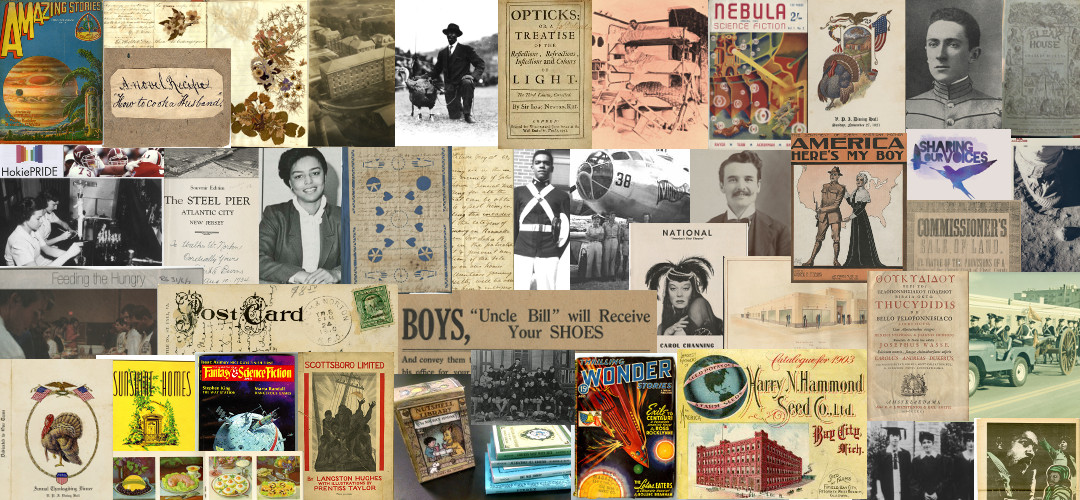
If you can’t join us in October, we’ll have two more open houses this semester: November 5th and December 2nd (both Tuesdays and both from 5-7pm), so be sure to mark your calendar. See you soon!