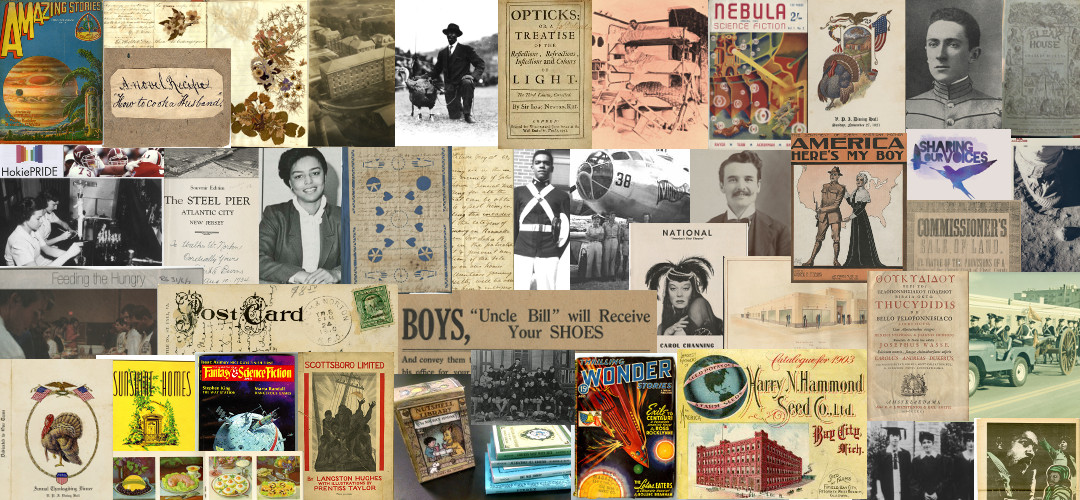
Have you ever heard the term “vertical file”? Typically, when researchers come in to learn more about a topic, the first place to look is in our vertical files. These are generally folders of newspaper clippings, brochures, press releases, and other items that are arranged by subject. The term itself derives from the vertical filing cabinets that archives may use to hold these collections [for your information, Special Collections uses boxes rather than filing cabinets].
Special Collections has several sets of vertical files:
But I’d like to tell you specifically about the Record Group Vertical Files. This collection is specifically about departments, offices, and colleges at Virginia Tech, including materials advertising the university and articles about it. For example, below is a postcard advertising the Virginia Tech College of Science, the Advisor’s Manual for the VT College of Arts & Sciences, a blank application for the VT Graduate School, and an issue of the Carilion Clinic Report about the VT Carilion School of Medicine and Research Institute.
Postcard for the VT College of Science
Advisor’s Manual for the VT College of Arts & Sciences
VT Graduate School Application
Report about the newly opened VT School of Medicine
Blank form for the VT College of Arts & Sciences’ Academic Dean’s List
In addition to the educational colleges and departments of the university, we have materials from the operational offices and student groups. Below are examples, including brochures for the Perspective Gallery and HokiePRIDE, an official VT flyer in Arabic, a program for the Alpha Kappa Delta National Sociology Honor Society, and an article about the Muslim Student Association.
Brochure for the Perspective Gallery
Arabic flyer about Virginia Tech for international students
Brochure for HokiePRIDE
Article about Muslim Student Association
Program for Alpha Kappa Delta Initiation Ceremony
The finding aid for the Record Group Vertical Files describes some of these groups when possible, including administrative history, former names of units, topics within the terms, and references to other related groups.
Whenever you are looking up the history of the university and you don’t know where to start, this collection is a great first choice. The same holds true for looking up any subjects in all the vertical files we have!
Over the course of three decades, an ex-Confederate soldier named Catlett Conway dutifully wrote a string of letters to his half-brother, Dr. William Buchanan Conway, or Willie, of Athens, Georgia. While some of the letters are addressed to Catlett from his daughter Mary Wallace or brother John, most of the letters begin with My Dear Brother, or Dear Willie, and always inquired after the health and happiness of all members of the family. William Conway, five years Catletts junior, served as the Physician and Surgeon for Virginia Agricultural and Mechanical College the school we now all know as Virginia Tech in 1871 and moved to Athens twenty years later to run his own practice and contribute to medical journals. Catlett himself attended the University of Virginia in Charlottesville prior to the start of the war. Catlett often congratulated William on his published articles, which Catlett sought after and read with great interest.
Catletts own employment story followed a more scattered path over the years, as he held bookkeeping positions at the Richmond Granite Company and Richmond-based coal and tobacco companies. In his letters, he often recounted the events in a course of a typical day: what time he rose from bed in the morning, what time he ate breakfast and what he ate, how long he spent at his job and who visited him at his office, what time he ate dinner and what he are, and what time he went to bed. He was devoted to routines and considered any opportunities to read books and letters by the fireside in the evening to be his favorite time of every day. Throughout the letters, one can follow the development of gas and electric lighting, as Catlett often complained that his eyes were growing weaker as he got older, but advances in medicine and electric lighting helped him to continue his letter-writing up until the collection concludes in 1920, while he was in his eightieth year of age.
Catlett Conway was 52 years old when he was writing in 1892, meaning that he would have been among the many twenty-something-year-old men whose lives were changed forever by the Civil War and the considerably fewer who survived. Catlett refers to his Civil War experiences, as well as his attitudes toward Reconstruction, in many instances throughout his letters often in response to a new article or work of history that adds to Civil War literature. Catletts response to these pieces often fall into line with a sentiment of other ex-Confederates of the day who longed for the return of power to Old Dixie. Catletts memories of the war often lapse between wistfulness and pain, remembering the horrors of war among flashes of rosy prewar childhood memories. Occasions of dissatisfaction with new national directives for racial, political, social, and international policies are scattered among touching musings on heaven and the afterlife. Many of Catletts letters paint a unique, complicated picture of the Civil War and its legacy in public memory decades after its conclusion.
Catlett Conway writes to Willie on April 6, 1902, expressing his desire to write for publication on the subject of the Civil War — “I think of many subjects I think of importance which I would like discussed in the daily papers but which no one else seems to think of” — before sharing details of the Conway family genealogy.
Finally, many of Catletts longer, more detailed letters have to do with the subject of travel and perceptions of his surroundings. Later in life, Catlett did a surprising amount of traveling especially by train to visit children, grandchildren, siblings, and cousins throughout the country. These letters give vivid accounts of train travel along mountain ranges (such as the Blue Ridge and Alleghenies), over rivers and gorges, and through rolling hills and fields in Virginia, West Virginia, Maryland, Ohio, and other states near and along the east coast. Catlett recalls everything from the meals given on the train to the bustle of the train platforms upon arrival and the details of family walks throughout cities such as Baltimore and Cincinnati. By the end of his life, Catlett had moved from boarding houses and the homes of his daughters to settle in Philadelphia, Pennsylvania, where he often participated in Civil War-related events and reunions for veterans. Whichever city Catlett occupied, his letters always contained in-depth commentaries on that citys social, political, and economic situation as he perceived it.
Image taken from Catlett Conway’s entry on FindAGrave.
Catlett Conway died in Philadelphia, Pennsylvania in December of 1929 at nearly 90 years old. As Ive gotten to know Catlett in the later years of his life, Ive been able to keep track of his mental and spiritual growth, as well as his fluctuating health, until his death. Catletts prolific eloquence as evidenced by this collection holds a lot of potential for anyone interested in multiple interest areas, such as the Civil War, Reconstruction, the Gilded-to-Progressive Age; advances in technology, transportation, and medicine; the changing climates of race, gender, culture, the military, politics, foreign relations; everyday life in an American city the list goes on and on. From thoughtful personal insights and bold opinions and claims to musings on the state of the nation and the world, its as if Catlett Conway somehow knew that he had the potential to serve as an incredibly rich source of interest for purposes of research and just plain curiosity. You can find the entirety of the collection available online here.
Only four Virginia Tech football players have had their numbers retired: Carroll Dale, Frank Loria, Bruce Smith, and Jim Pyne.
Carroll Dale with coach Frank Moseley, 1960 Bugle, p. 336
No. 84 Carroll Dales jersey was the first to be retired. Born in Wise, Virginia, he entered Virginia Tech in 1956 as an offensive and defensive end. After seeing varsity action as a reserve in the first game of the 1956 season, he started in the remaining 39 games of his college career. He became V.P.I.s first bona fide All-American. As a junior in 1958, he was named the Southern Conference Player of the Year, and for three consecutive years (1957-59), he was voted the Roanoke Touchdown Clubs Lineman of the Year. He was team captain his senior year and earned first team All-American honors. In all four seasons, he led the Hokies in pass receiving. Dale finished his college career with 67 receptions for 1,195 yards and 15 touchdowns. He was inducted into the College Football Hall of Fame in 1987.
Following graduation, Dale played five seasons with the Los Angeles Rams. He scored on a 57-yard touchdown pass in his first NFL game. The highlight of his professional career came with the Green Bay Packers and three straight National Football League championships under coach Vince Lombardi. The 1967 and 1968 games were known retroactively as Super Bowl I and Super Bowl II. After eight seasons in Green Bay, Dale played a season with the Minnesota Vikings when he found himself again in the Super Bowl. He was inducted into the Packers Hall of Fame in 1979. Carroll Dale Stadium, the football stadium of Dales high school in Wise, J.J. Kelly High School, was named for him.
Frank Loria, football All-American
No. 10 Despite his 5-9, 175-pound frame, Frank Loria was one of the most tenacious football players ever to play for Virginia Tech. A native of Clarksburg, West Virginia, he played basketball, baseball, and football at Notre Dame High School. When he came to Virginia Tech, Loria started every game at safety from 1965-67 and rapidly established himself as one of Techs all-time greats. He was famous for his uncanny ability to diagnose opposition plays and was called a coach on the field. Loria was the first Virginia Tech football player to gain first-team All-American honors in back-to-back seasons (1966, 1967), and he became the Hokies first consensus All-American pick as a senior in 1967, making seven first-team All-American squads. During his Tech career, he had seven interceptions and a number of punt return records. He returned 61 punts, averaging 13.3 yards on each return. He ran four punts back for touchdowns. One was a school record 95 yards.
Loria was assistant coach at Marshall University on Nov. 14, 1970 when all players and coaches died in a plane crash. The tragic accident took 75 lives. Loria was 23 years-old and was married with two children and a third on the way. He was inducted into the College Football Hall of Fame in 1999. In the 1970s Frank Loria Memorial Field opened in Clarksburg City Park. Notre Dame High School plays its home games there.
Bruce Smith battles Clemson, VT Sports Information photo
No. 78 Known as The Sack Man of Virginia Tech football, Bruce Smith capped his sensational college career in 1984 by winning the Outland Trophy as Americas top lineman. The Norfolk, Virginia native graduated from Booker T. Washington High. Following an all-state high school career, Smith accepted an athletic scholarship to Virginia Tech where he had a career total of 71 tackles behind the line of scrimmage for losses totaling 504 yards. Sports columnist Wilt Browning from The Greensboro Daily News noted that in four years Smith accounted for losses totaling more than five times the length of a football field (504 yards). Smith had 46 career quarterback sacks, including 22 during his junior season in 1983 when he was named first-team All-American. In 1984 he was a consensus All-American. His combination of strength, quickness, intelligence, and relentless effort made him the model for a pass rushing defensive lineman.
In the 1985 National Football League draft, Smith was the first selection of the Buffalo Bills. During his pro career, he established himself as one of the greatest defensive players ever to play the game. He was NFL Defensive Player of the Year in 1990 and 1996, when he was named to the NFLs All Decade Teams of the 1980s and 1990s. He was selected to 11 Pro Bowls. He was inducted in the Pro Football Hall of Fame in his first year of eligibility on August 8, 2009. He ended his 19-year pro career in 2003 as the NFLs all-time sack leader with 200. He anchored a defense that reached four straight Super Bowls. The Bills retired his No. 78 jersey in 2016. It joined Jim Kellys No. 12 jersey as the only numbers retired by the Bills. No player had worn number 78 since Smith left the team.
Bruce Smith served on the Virginia Tech Board of Visitors from 2002 to 2003.
Jim Pyne in action against Miami Hurricanes, VT Sports Information photo
No. 73 Center Jim Pyne became Virginia Techs first unanimous All-American when he made all five major teams that were selected in 1993. In addition to All-America honors, he was named winner of the Dudley Award as Virginias Player of the Year. During his four seasons at Virginia Tech, he established himself as one of the Hokies top linemen of all time, leading the charge that rewrote the record books for scoring and total offense. He started 35 consecutive games and 41 of the 42 Tech games in which he played. He allowed just one quarterback sack by the man he was assigned to block during more than 2,700 career snaps. He played on 736 of a possible 770 snaps during his sophomore season. That translated to 96 percent of the Hokies plays on offense. He played every offensive down in six games that season and graded higher for his performance on the field than any lineman during Coach Frank Beamers first five seasons at Virginia Tech. He earned second-team All-BIG EAST Conference honors his junior year and was named to the leagues first All-Academic team. He played on 92 percent of the teams offensive snaps and set a school weight room record with a 401-pound hang clean.
He helped clear the way for a record-setting offense in 1993 as Tech earned its bid to the Poulan/Weed Eater Independence Bowl, the first bowl bid of the Beamer era. VT won 45-20 over Indiana. He was named to the Big East Conference All-time team at the turn of the century. The offensive line meeting room at VT was named in his honor.
A native of Mitford, Massachusetts, he attended Milford High School, where he played for the Milford Scarlet Hawks and Choate Rosemary Hall in Wallingford, Connecticut where he played for the Choate Wild Boars. The Pynes were the first family to play three generations of professional football. Pynes father, George Pyne III, played for the Boston Patriots of the American Football League in 1965. His grandfather, George Pyne II, played for the Providence Steam Roller of the NFL in 1931.
Pine was selected by the Tampa Bay Buccaneers in the 1994 draft, and he played four of his nine professional seasons with them as a left guard, starting in 38 of his 42 appearances from 1995 to 1997. He played for the Detroit Lions in the 1998 and then became the first overall pick of the Cleveland Browns in the 1999 expansion draft. He was named team MVP by the Akron Browns backers and named top offensive lineman by the touchdown club.
New Policy on Retiring Numbers
In 2002, the Virginia Tech Athletics Department developed a new policy on retiring football jerseys. This special honor is bestowed to acknowledge an individual who has won an established national award in his sport, while allowing the number to continue to be worn by others. Virginia Tech no longer retires numbers.
Visit Special Collections
We have historical sports and other photographs, biographical files, sports programs and media guides in addition to many other treasures in Special Collections. We hope to welcome you.
Here at Special Collections, one of our goals is to acquire materials that people use for research and personal interest. On the blog, we talk a lot about different formats of collections, different topic areas represented, and even different uses for those collections. When we work with researchers, especially students, we talk about collections as primary sources: first hand accounts of events, place, people, etc. One of the forms that these primary sources can take (and one we don’t talk about quite as much as personal letters or diaries, for instance), are business papers. But, collections of business papers (letters, ledgers, account books, and the like) can tell you plenty. This week, I thought I’d share one such collection: theChilhowie Milling Company Correspondence from 1916 and 1917.
Letter from Norolk & Western Railway Company, February 24, 1917
Letter from Nordyke & Marmon Company. Inc., June 19, 1917
Letter from Stone Printing & Mrg. Co. (Roanoke), October 22, 1917
Handwritten order from Bluefield, WV, December 1917
Freight bill from Norfolk & Western Railway Co., November 24, 1917
Handwritten sketch, possibly a proposed plan for the revision of the mill, n.d. (c.1917)
You can view the finding aidfor this collection online, though it isn’t one we have had a chance to digitize in its entirety just yet. You may notice that the finding aid says this collection was previously processed, but in 2015, we did some additional organization and description. We don’t have the time and opportunity to revisit every collection, but when we can, we like to try and improve access. In this case, there was a brief description of the collection, but no contents list or detailed notes. Plus, we discovered that the collection had originally been described as theChilhowie Mining Company Correspondence. The milling company corresponded with a number of mining and ore related companies, but its missionwasn’t mining.
So, why look ata collection like this? It can tell you about business in the context of local history (or local history in the context of a business)–in this case, a business that existed in Smyth County, Virginia for over a century. You can get a sense of what it took to run a large business, the corporate partners and/or suppliers needed, the raw materials gathered, and, in this, what it took to renovate and rebuild. In atwo year period, the Chilhowie Milling Company wrote back and forth with nearly 40 different parties. To name a few specialized companies, this list included:
Bank of Glade Springs
B. D. Smith and Brothers Printers
Bristol Door and Lumber Company
Crystal Springs Bleachery Company
Ferger Grain Company
Fulton Bag and Cotton Mills
Gruendler Crusher and Pulverizing Company
Invincible Grain Cleaners Company
Millers National Insurance Company
Norfolk and Western Railway Company
State of Virginia Dairy and Food Division
Virginia Iron, Coal, and Coke Company
Virginia Leather Company
Virginia Portland Cement Company
Westinghouse Electric and Manufacturing Company
In the cases of some other business history materialsat Special Collections, there might be even more to be learned! Interested in the personnel rosters of a textile mill? The account ledgers of a local grocery store? Records from a Saltville salt supplier during the Civil War? You might want to stop by and see us. You never know what new tidbits are to found, what reflections you might find on a given economic situation, or even what family history you can discover in business records!
The International Archive of Women in Architecture includes over 2000 cubic feet of unpublished primary sources (manuscripts, photographs, drawings, correspondence, business records and more). Researchers visiting Special Collections at Virginia Tech also have access to hundreds of published books, catalogs, documentaries, and encyclopedias about women in architecture and design. Many of these publications are scholarly or autobiographical in nature, but our growing collection of supporting materials also includes published ephemera (follow this link to learn more about the research value of ephemera) which shed light on the hidden contributions of women to design.
Publications like trade cards and catalogs, advertisements, and event posters represent fragments of evidence for the work of pioneering women architects and designers. The bulk of our resources in this realm reflect the contributions of women in the United States of America, working in an era where women had limited access to formal architectural education and licensure. These materials rarely divulge biographical details about their subjects, but suggest future possibilities for intrepid scholars.
Here are three examples that hint towards hidden contributions of women:
Vintage catalogs of house plans
Early 20th century designers in the US advertised their house plans by distributing colorful, eye catching catalogs to homebuilders, lending agents, and manufacturers. The Garlinghouse Company was founded around 1910 by homebuilder Lewis F. Garlinghouse of Topeka, Kansas. Advertising for decades under the tagline Americas Pioneer Home Planning Service, Garlinghouse Company was among the first and most prolific seller of home plans in the US. Iva G. Lieurance was the companys principal house designer, and her plans appear in several catalogs through the 1950s. We know little about her work beyond what we can glean from the catalogs. She may have worked for the company as early as 1907, traveling around the country to document attractive homes and adapt their floor plans for customers in the midwest. An application with the Maryland Historical Trust calls Lieurance the only known woman credited for design work associated with the mail-order house movement.
Garlinghouse Company catalog, “Sunshine Homes”, feat. designs by Iva G. Lieurance. (1938)
Lieurances credentials and her relationship to L.F. Garlinghouse may be lost to history. According to the 1940 census, 53 year old Iva G. Lieurance lived with her elder sister in Topeka, Kansas as head of the household. Her occupation is recorded as Designer of Home Plans and she reported working 50 hours per week. The census worker recorded 8th grade as the highest level of education she had completed. The 1954 Topeka, Kansas City Directory lists her as a designer for L.F. Garlinghouse, indicating a long and prolific partnership with the company.
Other collections in the IAWA suggest that residential design was more accessible to American women in the early 20th century than industrial or large-scale commercial work. Like Iva G. Lieurance, many pioneering women represented in the IAWA managed to apply their trade through creative partnerships that worked around credential barriers.
Coades Lithodipyra or Artificial Manufactory Trade Card
Worlds Fair Posters
The Town of Tomorrow and Home Building Center Souvenir Folder, a collection of ephemera from the 1939 New York Worlds Fair, offers another glimpse into the historic contributions of women to design. Documenting an exhibition of 15 model homes, the collection of brochures features a design by one Verna Cook Salomonsky. Unlike Iva G. Lieurance, Vernas contributions are somewhat well known. She first practiced architecture with her husband Edgar. Continuing as a solo practitioner after his death, she designed and oversaw construction of hundreds of homes in New York, Connecticut, Pennsylvania, and California. She also wrote extensively about Mexican design traditions with her second husband, Warren. Her archives are maintained by the University of California at San Diego. Having partnered with a spouse or family member before branching out on her own, Verna Cooks career reflects another common path for pioneering women architects.
Demonstration Home Brochure No. 12, “Town of Tomorrow” Model Village, New York World’s Fair, 1939. Designed by Verna Cook Salomonsky.
I love stumbling across letters in our collections that offer a glimpseof everydayromance. It’s something we can all relate to. So I when I came across a letter while digitizinga collection from a Confederate soldier confessing his feelings of “somethingmore than friendship, farexceeding gratitude,” I was excited to share.
The letter, found in the Koontz Family Papers,was written by Angus Ridgill, a private from Alabama, to Nellie Koontz, a young woman living in the Shenandoah Valley, in August, 1863. The letter was ostensibly written as a thankyou note toNellie and her family for housing him recently as a lone soldier, but Angus also uses the opportunity to confess his infatuation with her.
First page of Angus Ridgill’s letter to Nellie Koontz, dated August 17, 1863. See it online here
He writes:
“I amnaturally a creature of impulses, and the first fewmoments I passed in yourcompany was sufficient tomake me entirely subservientto your will, be that what it may.”
He continues with assurances that this confession was not hisoriginal intention of the letter, that he doesn’t expect his feelings to be fully reciprocated, and can only wait for an appropriate response-
“still I do trust thatyou will allow me time andopportunity to prove anythingwhich you may wish to know…”
He finishes with an apology:
“if all thistime I have been presumingtoo much upon your formerkindness I most humbly askyour pardon, hoping at thesame time that I havenot forfeited your friendship.”
Whether Angusever received a response from Nellie is notknown. But seeing as this letter was not immediately torn to shreds, but instead, carefully saved alongside those from her brothers and cousin (who were also off fighting for the Confederacy), we can assume his message hadsome significance to her.
An ‘A.G. Ridgill’ is listed as a private in the Washington Battalion, Louisiana Artillery, andinthe 1870 census, Angus Ridgill is listed as age 24, making himonly 16 or 17 when he wrote this letter. Inthe 1860 U.S. Census, Ellen F. ‘Nellie’ Koontz was listed as 16 years old, making her19 in 1863 at the time ofthis letter. I guess this provesteenage love messages were alive and well 150 years ago, just with more cursive and less emojis.
Sadly, census records also tell us that Angus and Nellie didn’t end up together. In the 1880 census, A.G. Ridgill, now 33, is listed as living in Van Zandt, Texas, working as a farmer and married to an Elizabeth, age 29. Alsoliving with him is an 8 year old step son, and two daughters, ages 5 and 3. In the same yearNellie, now listed as Nellie F. McCann, is married to N.F. McCann, an editor, and also has ason, 8, and two daughters, ages 4 and 2. Hopefully they both found true love with their respective spouses and were happy with their marriages and families at this stagein their lives.
In addition to thisletter, the Koontz Family Papers contains correspondence from brothers George and Milton Koontz and their cousin George Miller, each of whom served in the Confederate armies of Virginia. The collection also includes letters sent from other friends and two diaries and a sketchbook from Milton Koontz. The entirety of this collection is now online, including transcripts. Take a look at the collection here.
Where are you from? is one of the first questions people ask when meeting someone new. Knowing where a person is from is a way to understand, connect, or relate. Where you are from does not define you but it adds important contextual information.
For archivists and people doing archival research, the origins of documents, photographs, or objects is crucial. Where the material comes from, who owned it, what person or organization created it, and how it relates to other material from the same origin is known as provenance. This principle guides the decision to acquire new materials through donation or purchase, as well as how to arrange and describe the material.
A few weeks ago I received a call from a local book and manuscript dealer who frequently acquires local and university history materials. Usually they have letters, photographs, and old books to offer. But this time, the dealer had a snare drum that belonged to a Virginia Tech cadet from the 1940s. As I frequently tell people, Special Collections is a research archives and not a museum of objects. So at first, this offer seemed like an easy one to dismiss, until I learned the provenance of the drum.
Robert V. Kelsey, from The Bugle, 1942
Robert V. Kelsey was the owner of the drum. Robert grew up in Blacksburg and followed in the footsteps of his father V.E. and older brothers Donald and Paul by attending Virginia Tech. He enrolled in 1941 and was in the regimental band.
Music, movies, and theatre were a large part of Robert’s youth. His father was vice president and general manager of the Commonwealth Theatre Corporation. The Kelsey family owned the Lyric Theatre from when it opened in 1930 until 1989. The family also owned and operated the Little Theater on Main Street.
The regimental band in 1942, The Bugle, 1942
After two years of study Robert joined the Air Force and began pilot training. On October 1, 1944, Robert was injured in a plane crash at Courtland Army Air Field in Courtland, Alabama. He died the next day. As recognition for his service, R.V. Kelseys name was etched into the pylons at the War Memorial Monument alongside the names of other Hokies who made the ultimate sacrifice for their county.
What began as an offer of an old snare drum, which I first thought belonged in a museum somewhere, turned into a much more compelling story. The provenance connected the item to its owner and made further discovery possible. With that information I found his picture in The Bugle, read his obituary notice in The Techgram, and discovered his named etched into stone a mere ninety-five feet from Special Collections. That power of provenance creates connections and makes seemingly static, inanimate objects, documents, and photographs come alive.
It was an easy decision to acquire Kelseys drum and make it available for future generations of Hokies. Because archives do not usually collect drums, a custom box has been ordered. In the meantime I am sharing my desk with this unique item. So stop by, take a look at the drum, and tell me where you are from.
Masthead for the Veterans in Society Summer Institute
For months, co-directors Jim Dubinsky of the English Department and Bruce Pencek of the Library, along with Heidi Nobles have been working to plan and seeking to provide for every detail necessary to make this three-week long NEH-supported Summer Institute for College and University Teachers a reality. This past Monday (the 11th) was the first day in a schedule that will have the 25 extraordinarily accomplished participants from all over the country in Blacksburg this week and in D.C. next week before returning to Blacksburg for the third and final week of the program.
The official name of the Institute is “Veterans in Society: Ambiguities and Representations.” The impressive list of faculty include Jonathan Shay, author of Achilles in Vietnam: Combat Trauma and the Undoing of Character and Odysseus in America: Combat Trauma and the Trials of Homecoming. Among his other accomplishments, Shay has served as the Chair of Ethics, Leadership, and Personnel Policy in the office of the U.S. Army Deputy Chief of Staff for Personnel and, in 2007, received a MacArthur fellowship for his work on trauma and the moral injuries of war. Jim Marten is past president of the Society of Civil War Historians, author many books, including Sing Not War: Civil War Veterans in Gilded Age America and the award-winning The Children’s Civil War. Donna Musil is a documentary filmmaker, writer and activist, whose film, Brats: Our Journey Home will be shown as part of a three-show film series that is open to the public. More about that in a moment. Actually, these are just three of the stellar faculty that are participating in the Institute along with Tech’s own Paul Quigley, Director of the Virginia Center for Civil War Studies and James I. Robertson, Jr. Associate Professor of Civil War History; Edward Fox, Professor of Computer Science; and David Cline, also from the History Dept. and who specializes in 20th century U.S. social movements, oral history, and public history. You get the idea . . . and I’ve left all kinds of folks out. For a complete list, see the Institute’s terrific website.
So, what is it that all these fine folks have come to Virginia Tech to discuss and study? Broadly speaking, they are defining the dynamic that may be leading to the emergence of a new interdisciplinary field, that of Veterans Studies. More specifically, the topics range widely, from the ways in which classical literature may play a part in understanding and assisting veterans to the role commemoration and monument building play in cultural memory and the process of reconciliation following war; from the ways in which stories of military service can be captured in oral history to a consideration of the unique perspectives offered by women veterans; from asking, “Who is a veteran?” and considering the social status of veterans to the effects of war on military children and the ways the voices of veterans emerge in music and literature . . . and everything in between and beyond. The reality is that the fact and aftermath of military service define threads that run through every culture, across the generations, and have an impact on the most significant aspects of life and society. Through the seminars, presentations, and activities listed on the Institute’s syllabus, the participants will seek to investigate these and other questions, while defining the beginnings of individual research projects.
Display of materials related to veterans at Special Collections for the Summer Institute
On their second full day in Blacksburg, the members of the Institute had an opportunity to hear about collections of primary sources that may be of interest to them at Special Collections. We set up a display of a few documents and other items and, after a brief introduction, made that exhibit available to them, and to the library community for much of the week. While some of the materials have been displayed before, there were several items that have not been exhibited in recent memory.
Theophilus Cocke Letter, 1907, Ms2008-057
For example, to the right is a scan of a letter written in 1907 by Theophilus Cocke of Carroll County, Virginia. Mr. Cocke was a veteran of the Mexican War (!) writing about the provisions of a new pension bill that would raise his allotment from $12 per month to $20.
In a letter written from Kansas in June 1865, H. E. Norton complained that veteran members of his Michigan Brigade were due to be mustered out following the end of the Civil War, but were instead sent west. He writes, “[I]t is Generally Believed that the Michigan Brigade was Basely sold by the Governor of the State of Michigan for we could never have been transfered to this Dept. if he had not consented to it.” Norton ended up in Nebraska Territory. Extended tours are, apparently, nothing new.
From the Conan W. Vaughan Papers, Ms1991-050: photographs from the European theater, 1945; a copy of Stars and Stripes; a French 10 franc note; and a piece of a German Ju-88 shot down over Iceland
Once in Washington, the Summer Institute participants will spend a day at the Library of Congress and visit Arlington National Cemetery. They’ll talk about the LC’s Veterans History Project and stop at the Confederate memorial, Arlington House, and the U.S. Colored Troops graves. On the way back to Blacksburg, they’ll stop at the D-Day Memorial in Bedford.
Back in town, there will be more seminars, more opportunity to explore topics of interest, and to discuss ideas with the other participants. More time to check out primary sources.
Veterans In Society Summer Institute Presents Film Night
There is also a public component to all of this. The Institute is sponsoring a Free Movie Night. The showing of Coriolanus has already gone, but on July 21st they will be showing The Best Years of Their Lives, a terrific, Oscar-winning movie about returning World War II vets, and on July 25th will be a showing of Brats: Our Journey Home, the documentary mentioned above, with writer and director Donna Musil on hand. These shows begin at 7PM in the MultiPurpose Room on the first floor of Newman Library. Again, the public is invited and admission is free!
If you are curious what Special Collections looks like behind the scenes, Kira Dietz showed a glimpse of onsite storage previously in this blog. Well, we also have offsite storage in the Library Storage Building, managed by the University Libraries. In addition to Special Collections, Newman Library and the Records Management Department house material at the storage building. Unlike storage onsite, the shelving is so tall and aisles so long, special equipment is used to access materials up to the top and down the rows.
Library Storage Building, showing the lengths of aisles and some of the maps we house out there (before they were placed in boxes) alongside the University Libraries’ offsite books and other publicationsLibrary Storage Building, showing the height of aisles – on the right side you can see some of the archives boxes and architectural drawings from Special Collections
Special Collections houses our large manuscript collections, most of which are accessed less frequently than onsite storage. Space is available where we can work, but we have to schedule with the other departments, who use the same office space. Recently, several students and I have been working on collections housed offsite, including the William C. Wampler Congressional Papers with 250 boxes of files from Hon. Wampler’s nearly two decades in the U.S. House of Representatives and the Pocahontas Mine Collection, which is approximately 900 cu. ft. with over 7,000 maps of mines in southwestern Virginia and Appalachia operated by CONSOL Energy and its predecessors (look out for more info on this collection when processing is done).
A student worker reviews a map from the Pocahontas Mines Collection at Library Storage Building. Some of the maps like this one are so large, we have to unroll them bit by bit and weigh them down to view them during processing.Processing the Wampler Papers and other such large collections offsite means we have to temporarily store them in the hall and in the shared office space before they can be reshelved!The Wampler Papers during processing at the Library Storage Building
The University Libraries are currently working on another offsite storage building, this time with movable shelves. Movable shelves greatly increase the storage capacity in locations, but need strong floors to keep them stable! We also have a small, secure space in the basement of Newman Library that is shared with the rest of the library for temporary storage for our larger or more unwieldy collections, such as part of the Avery-Abex Metallurgical Collection with over 200 containers, many in unusually types and sizes.
Examples of unique shelving that came with one of our collections
Avery-Abex in basement
I hope that you’ve enjoyed this look behind the scenes!
Some of us carry around images or a sensibility of the 19th century, often for no other reason than to be able to see or hear something and to instantly be able to say, “Ahh, that’s soooo 19th century.” OK, maybe not many of us. For one friend of mine, the slow-moving Connecticut River on a summer day and away from the sound of traffic was 19th-century perfection. We’re not talking nostalgia here, just the satisfaction of a fitting image. Perhaps nobody has offered a more fitting and memorable image of that century than Theodore Adorno, when he said, (in one of my most favorite quotes about anything):
“In the nineteenth century the Germans painted their dream and the outcome was invariably vegetable. The French needed only to paint a vegetable and it was already a dream.”
Don’t I wish I’d said that! My own images of the 19th century include a movement towardsif not culmination ofclassification and encyclopedism, as well as the invention of complex or specialized mechanical devices. The dynamic of these two trends rush over the beginning of the 20th century the way a huge post-romantic symphony might be understood to have already overflowed its orchestral banks . . . but without yet doing serious damage to anything.
Romeyn Beck Hough
Romeyn Beck Hough (18571924) was a 19th-century American botanist and son of Franklin Benjamin Hough, the first chief of the U.S. Division of Forestry, a man routinely noted as the first leader of the American forestry movement and, sometimes, as the “father” of American forestry (along with Gifford Pinchot). The son’s work, The American Woods, pictured above, is the subject of this post because it seems, to me, at least, emblematic of these two trends.
The full title of the work pictured above is The American Woods: exhibited by actual specimens and with copious explanatory text, and for Hough it was his life’s work. Although he didn’t do the classification himself, he was very keen on comprehensive exhibiting and explaining based on the classification. He began working in 1883 on this project, which had as its goal nothing less than the representation of all American woods. Photographs, of course, would not be an adequate means for representing the wood, so in fine late 19th-century style, Hough provided actual samples of each . . . in three different sections, transverse, radial, and tangential. These specimens, thin enough to be translucent when lit, were, as Hough explained, “mounted in durable frame-like Bristol-board pages, with black waterproofed surfaces . . . and each bears printed in gilt-bronze the technical name of the species and its English, German, French and Spanish names.” As Hough said of the work, it is “illustrated by actual specimens, and being in this way an exhibition of nature itself it possesses a peculiar and great interest never found in a press-printed book.” In Hough’s obituary, William Trelease wrote of the use of the woods themselves as illustrations,”[they], unlike texts and drawings, never can become out-of-date nor be found to contain untruths except as the names applied in his day to the trees he sectioned undergo change with progressing knowledge.” (Science, Vol. LX, No. 1557, October 12, 1924).
Sourwood
Butternut
Sumac
Chili Pepper
Emory Oak
Hickory
Red Alder
Oak
Olive
Alder
Dogwood
Papaw
Leather Leaf Ash
California Sycamore
American Beech
Silky Oak
Red Maple
The project was planned as a 15-volume series to be arranged according to geography and released over a number of years. The first three volumes, first made available in 1888, represented the woods of New York, Hough’s home state. Each volume contained, in addition to at least 25 mounted and framed sets of samples, a booklet that offered the “copious explanatory text,” including a “systematic study” of the woods represented in the volume. This material described each trees physical characteristics, growth habits, habitat, medicinal properties, and commercial uses.
So, that’s the “classification/presentation” part. What about the mechanical? In order to exhibit samples at the required thinness, Hough had to invent the means to produce them! Of course. In 1886 he received a patent for a device that could cut wood to a thickness of 1/1200th of an inch, far thinner than required for The American Woods project. In fact, ever the entrepreneur, Hough’s purpose for the device as stated in the patent materials was, “to provide flexible wooden cards suitable for use as business or fancy cards, or cards for use in photography, the arts, &c. . . .” The following advertisement could be found inside early editions of The American Woods:
Advertisement for Hough’s Wooden Cards
In another ad, also for the same “Wooden Cross-Section Cards,” the text reads, “It was found in the early experiments in sectioning and preparing specimens for AMERICAN WOODS, that the transverse sections of certain woods were of surprising strength and smoothness, and suitable for cards for commercial purposes.” Not the least of which was advertising The American Woods itself.
Advertisement for The American Woods on one of Hough’s Wooden Cross_section Cards (from the Library of Congress)
These were not the only uses for Hough’s wood slicing device. Back in the realm of botany and biology, Hough produced slides that could be used by magic lantern projectors allowing the fine detail of the woods to be seen and studied by groups of people. Lastly, using the capacity of the device to produce the thinnest sections, Hough also prepared slides for use with a microscope.
Slide for use with magic lantern projectorSlide for use with microscope
At the beginning of his project, Hough is said to have personally selected each tree that provided his samples. At least with regard to the 27 sets of sections that comprise the first volume, he writes in a November 1887 prospectus seeking subscribers:
“The author has been scrupulously careful about the identification of each tree, selected for the specimens, in the field, before felling it, while the leaves, flowers or fruit (one or all) have been obtainable, and he can vouch for the authenticity of every species represented.”
In 1889, The American Woods was awarded a grand prize at the Paris Exposition. By 1909, it had won medals at the Columbian Exposition at Chicago, Pan-American Exposition at Buffalo, the Louisiana Purchase Exposition in St. Louis, the Alaska-Yukon-Pacific Exposition in Seattle and the Elliott Cresson Medal of the Franklin Institute in Philadelphia. It was recognized as an essential resource and was reviewed as such.
Between 1888 and 1913, thirteen of the projected fifteen volumes were published in three editions at an initial price of $5.00 per volume. Extra or replacement specimen cards were available at $0.10 apiece, as announced inside the cover of several volumes. Hough’s aim was to “carry constantly a supply of such specimens.” Of the thirteen volumes, the first four covered the trees of New York and adjacent states, specimens in volume five were collected in Florida, parts six through ten represent the trees of the Pacific slope, eleven and twelve present the species of the Atlantic and Central states, while volume thirteen continued the collection of species from Florida.
Romeyn Hough died in 1924 before he could finish the project. What turned out to be the last volume in the series, the fourteenth, was completed by his daughter, Marjorie Galloway Hough, and published in 1928. It contained additional specimens from Florida. In all, the work presents 354 species and 1056 wood samples.
Romeyn Beck Hough with his samples, from California’s Magazine (1916), Hough’s “American Woods,” vol. 2, p. 285.
Special Collections has the first twelve volumes of Hough’s work. It is, for the most part, in fabulous shape. The fourteenth volume is particularly rare and we would like to complete the set, if we can.
But if The American Woods had a 19th-century genesis, its life and significance continued through the 20th and into the 21st centuries. In 1954, Robert Speller and Sons, publishers, determined that a large supply of Hough’s original samples still existed and were in the possession of Hough’s daughter, Marjorie. She supplied the specimens for a new edition of the work, published in 1957 and titled, Hough’s Encyclopaedia of American Woods. Eight new volumes of descriptive text was provided by Ellwood Scott Harrar, then Dean of the School of Forestry at Duke University, along with 16 volumes of samples. The samples were presented in much the same manner as the originals, three different sections of a single species mounted on individual cards.
Title page, Hough’s Encyclopedia of American WoodsSample, Hough’s Encyclopedia of American Woods
This newer edition may be found in Newman Library’s general collection. Though perhaps lacking the charm of the original edition, it includes 385 varieties of trees and 1161 separate samples, thus including examples that Hough had not been able to present in the original editions, but for which he had specimens. In fact, as recently as December 2011, Jon Speller, son of the publisher, posted a website on which he offered a collection of nearly 1.2 million individual wood specimens comprising the remainder of Hough’s own collection!
I have had the pleasure of showing the set in Special Collections to students, researchers, and woodworkers alike. The American Woods is a remarkable achievement. An unparalleled resource of its time, it remains an exquisite thing of beauty. It should then come as no surprise that in this centuryin 2002 and again in 2013Taschen, an art book publisher came out with The Woodbook, a volume that contains high quality photographic reproductions of all the original specimen plates from Hough’s original volumes, along with selected drawings and text.
The Wood Book, Taschen
Neither vegetable nor dream, of this century and each of the prior two centuries, and representing a lifetime of work, Hough’s The American Woods remains a testament to the beauty and utility of a fine piece of wood.