If you’ve visited Special Collections in the last 2 years, you’ve probably seen our reading room. (Although, if you were last here more than 2 years ago, the tables might have been a little different and if you were last here more than 8 years ago, we weren’t even in this space!)
Coincidentally, the space you can see into behind the open glass door is my office. So, now you know where to find me!
However, the reading room is really just the gateway to Special Collections’ secrets. So, this week, I took walk into the Rare Book Room and twoof our manuscript storage spaces with adigital camera.
Our historical photograph collection is in black acid-free boxes and is organized generally by topic. Beyond it, you can see some bound and boxed newspapers above and part of our collection of vertical files on university history below.To be honest, manuscript collections means lots of boxes on shelves.Seriously, I mean LOTS of boxes. In all kinds of sizes and shapes.These boxes contain rolled architectural drawings from two large IAWA (International Archive of Women in Architecture) collections.
One of our on-going projects at the moment (well, two on-going projects, now, but more on that below), involves managing all these boxes (and books!). Until the last year or so, everything was on shelves where it fit and we relied on a printed shelf list and/or our archival management software to tell us where things are. However, in late 2013, we launched the first phrase of a major reorganization. Most of our manuscript collections are now in order by number on the shelf. We still have some more things to move, but at the moment, we’re working on creating space for additional shelves (meaning we need to move some map cases). IAWA materials are located on separate shelving and will probably be reorganized in the future. Other future phases will involve reordering record group materials (in a smaller room past the map cases below) and flat files in map cases like these:
Boxes on top of these map cases contain textiles (which will be moved to new shelving soon) and architectural models.These cases, like the others above, contain architectural drawings stored flat. We have map cases throughout the department that also house oversize manuscript materials, unframed art, and historical university items.
Opposite the space where the manuscript collections are being put in number order is part of our Rare Book collection. (Some of it is also in an off-site library storage facility.)
Our rare books are shelved in call number order, but not all together. We have some shelved by size (so we can maximize available shelves) and others shelved by topic (like university publications and Civil War books). This photo shows a set of shelves containing “large” books, which for us means books over 28cm tall.We also have a fun collection of boys adventure books, which have spines that make for nice images.
We are also in the process of shifting our book collection in order to fit in one more range of shelving. (Space is tight and we’re exceptionally good atacquiring new materials!) It’s a long process, but it will give us much-needed wiggle room. For us, managing materials is always an active process, whether it’s adding a single new boxor moving 1,800 manuscript collections and 35,000 books.
Of course, there’s lots more to see and this is only a sneak peek.If you do pay us a visit and want to see more, please ask! We’re more than happy to take you on a tour beyond the glass door at the end of the reading room and into the stacks. We LOVE to share Special Collections and you’ll probably see something you might not discover otherwise!
Arthur Ballard Massey arrived in Blacksburg in 1918, ready to assume his duties as associate professor of plant pathology and bacteriology at Virginia Tech and as a researcher with the Virginia Agricultural Experiment Station. Just 29 years old, the Albemarle County native had already served as an instructor of botany at Clemson University for three years and as assistant botanist at the Alabama Agricultural Research Station for five. His tenure at Virginia Tech would span 40 years.
A. B. Massey, 1968
Educational requirements for careers in academia were not as stringent a century ago as they are today, and despite holding only a bachelors degree until 1928, Massey devoted most of his first decade at Virginia Tech to instruction. He taught all of the university’s bacteriology courses until 1924, and in that year was assigned to teaching full-time. In 1935, Massey became a botanist in the Virginia Cooperative Wildlife Research Unit, a position he would hold until his 1959 retirement; Masseys duties during these years became much more focused on research rather than instruction.
In a 1992 biographical sketch, Professor Curtis W. Roane wrote, “One might describe Massey as a complete botanist. He taught and conducted research in many phases of botany but he excelled in the taxonomy of Virginia flowering plants and will be most remembered for his collections and records of this flora.” Massey found the universitys herbarium to be a particularly useful teaching tool, and during his tenure, the herbarium steadily expanded. Massey is credited with adding 25,000 specimens to the collection, and in recognition of his contributions, the herbarium today bears his name.
While serving as chair of the Virginia Academy of Science’s Flora Committee, Massey cofounded the botanical journal Claytonia, a forerunner of today’s Virginia Journal of Science, and he worked with colleagues from the University of Virginia in establishing the Mountain Lake Biological Station. Perhaps most significantly among his accomplishments, Massey added greatly to the literature on the commonwealth’s flora, publishing such works as The Ferns and Fern Allies of Virginia (1944), Orchids in Virginia (1953), and Poisonous Plants in Virginia (1954).
In addition to several of these publications, Special Collections holds the Arthur B. Massey Papers (Ms1962-002). Among the papers are a number of essays and other works written by Massey and others on various botanical subjects. The collection also contains photographs and lists of trees on the Virginia Tech campus, valuable resources for studies of the campuss arboreal history and landscape development.
Within Masseys papers is this photo of an ivy-covered American chestnut in front of old McBryde Hall, ca. 1920. The tree would eventually be killed by the nationwide blight that decimated the chestnut population.
Also among the papers is an undated essay by Massey titled “Wild Flower Conservation.” In it, the botanist warns that exploitation has endangered a number of native wildflower species:
We have inherited, to a large degree, the notion that the native plants growing in the fields, meadows, and woodlands, the great out-of-doors, are there for the first to come (first come, first served, never mind who follows). Thoughtful Americans are awakening to the realization that some of our most interesting native plants are becoming rare and well nigh on to extinction… By education and example we need to develop a wild flower consciousness and a true interest in their conservation.
Page one of Masseys undated essay on wildflower conservation, probably intended for publication in Virginia Journal of Science.
Though the conservation of natural resources was no new concept at the time (the American conservation movement having its roots in the late 19th century), the paper was written years before conservation would enter the mainstream of American consciousness, and it shows a growing realization among naturalists that valuable species were being irrevocably lost to careless overharvesting. While Masseys little essay is hardly a landmark in environmental thought, it expresses views that the professor undoubtedly shared with students through instruction and with peers and the public at large through his writings and outreach, influencing the viewpoints of those he taught.
Here in the New River Valley, were fortunate to live in a region of abundant biodiversity. Though the landscape has altered dramatically since the arrival of the first Euro-American settlers, it remains in large part a healthy ecosystem. The preservation of this ecosystem remains the living legacy of A. B. Massey and the many naturalists like him who have encouraged us to learn about, to engage with, and to value the living things that we see around us every day. Thats something to keep in mind as we venture outdoors and enjoy the colorful changes that spring brings to the surrounding fields and woods.
And if youre unable to get outside, pay us a visit, and well be happy to pull some of the many books we have on the subject of flora (local, national, and elsewhere), a small, colorful sampling from which you can see below:
Wild columbine. From Flowers and Ferns of America (1885).
Trillium sessile. From The Botanical Magazine, v. 2 (1788).
Hay-scented fern. From Flowers and Ferns of America (1885).
Pink lady’s slipper. From Wild Flowers of the Alleghanies (1936).
Dogwood. From the North American Sylva (1857)
Common polypody. From The Native Flowers and Ferns of the United States in Their Botanical, Horticultural and Popular Aspects (1878-1880).
A couple of weeks ago, I had the privilege of speaking at Virginia Tech’s annual Civil War weekend. Not being a Civil War scholar, per se, and not wanting to just present a roundup of new acquisitions at Special Collections, however interesting that might be, I decided to talk about one collection, The John C. Watkins Letters, and, perhaps, give a little insight into the kind of window that even a few letters can open onto a life.
The collection consists of 17 letters, 11 of which were written during the war. The first nine were written while Watkins was a private in the 6th Massachusetts Infantry serving in and around Suffolk, Va. in 1862 and ’63. From Lowell, Massachusetts, he was 20 years old when he arrived in Suffolk.
Suffolk Va. Sept. 16th 1862 Dear folks at home, It is after Tattoo but I am determined to commence a letter for home and finish it when I can. . . .
Four more letters were written from Washington, D.C. from 31 March 1864 to 17 April 1866. Two were written from Camp Winfield Scott, Nevada in 1868. One other is from Winnemucca, Nevada, dated 17 January 1870, and though it was not written by John and despite lack of a last page and a signature, we know it was written by his wife. The final letter was written by John, but, again, is a fragment with no date or location specifically indicated, though clues in the letter may suggest a location.
Harpers Weekly, 2 May 1863: This view of Suffolk, Virginia possesses some interest just now in consequence of the attack of the rebels under Longstreet. The place has been fortified, and is held by a considerable force of Union troops under General Peck, who, it is said, feels satisfied of his ability to maintain himself. Suffolk is a small, filthy town of great antiquity, small population, little trade, and a great deal of Virginia dirt and Virginia pride.
The wartime letters are pretty straightforward in offering terrific detail about camp life and the battle known as the Siege of Suffolk of April and May 1863, as well as the movements and skirmishes that anticipated that action. But the other letters raise questions and often only offer tantalizing hints to their answers. What was Watkins doing in Washington? Or Nevada? Who did he marry? What happened to them after 1870?
Letter from Hattie Watkins to “dear home friends,” 17 January 1870, Winnemucca, Nevada
It’s not often that, as an archivist, one has the time to answer these questions. Usually, these questions and more are answered by researchers as the archivist moves on to other responsibilities. In my case, having been intrigued by the clues and the trails and traces of possibilities, I stayed with it, a little at a time. Census records, military records from the National Archives, and Wyoming(!) newspapers, among others, all helped to fill out the story.
Catalog of Georgetown College that shows John C. Watkins earned a Medical Degree, 1 July 1865Bill Barlow’s Budget, 13 April 1892
Well, that is just the start of a story that includes an M.D. from Georgetown College, travel to California, the Indian Wars, frontier medicine, Westward Expansion, marriage to Harriet (Hattie) Clark Clary of Deerfield, Ma., a decade as an itinerent physician, an active interest in mining, hired gunfighters and monied interests, the Johnson County Cattle (or Range) Wars . . . a short-lived stint as county coroner, and death. But there is also the backstory of a father named Ruggles who went west for the Gold Rush in 1850 and never returned; as well as the story of a sister, Mary, and wife, Hattie, who met(?) while teaching in one of the first post-war free schools in Richmond, traveled west, first joined and then outlived the brother and husband, and earned the right to be included in a 1927 publication, Women of Wyoming: Including a Short History of Some of the Early Activities of Women of Our State, Together with Biographies of Those Women Who Were Our Early Pioneers as well as of Women Who Have Been Prominent in Public Affairs and in Civil Organizations and Service Work (Casper, Wyo.: C.M. Beach). (You just have to love long subtitles!)
Maybe I’ll write it all up one day. It is a remarkable story.
Mary S. Watkins, died Buffalo, Wyoming; 26 May 1920
John C. Watkins, died Buffalo, Wyoming; 12 April 1892
Harriet Clary Watkins, died Buffalo, Wyoming; 21 November 1925
One small step for a man . . . one giant leap for mankind, Neil Armstrong spoke these immortal words when stepping from the Lunar Module Eagle onto the lunar surface on July 20, 1969. Just over eight years after President John F. Kennedy set a national goal for putting an American on the moon, Neil Armstrong, Edwin Buzz Aldrin, and Michael Collins brought that goal to fruition. While Armstrong and Aldrin engaged in a roughly two and a half hour EVA in the Sea of Tranquility, Michael Collins piloted the Command Module Columbia. Together the three astronauts made history.
Special Collections has an extensive collection of Michael Collinss personal papers and artifacts from his impressive and lengthy career as an astronaut in Projects Gemini and Apollo, director of the National Air and Space Museum, and published author, just to name a few. As can be imagined, the collection contains some pretty neat items, many of which give insight into one of the most exciting decades of space travel in the twentieth century.
Earthrise as seen by the Apollo 11 crew
Perhaps one of my favorite elements of the collection is a partial set of black and white and color photographic prints made from the film shot during the Apollo 11 Mission. Many of these images are so iconic they have become almost ubiquitous in popular memory. There are, however, also a great many that are not as recognizable but just as compelling. The photographs are stunning in their beauty, and it is easy to understand how monumental their impact must have been after their initial release. Although the images are fascinating themselves, the story behind the photographs is interesting as well.
Astrophotography was certainly not new by the time Apollo 11 launched in 1969. Indeed, people had been pointing their lenses skyward since the nineteenth century. Photos taken from space were not new either. Surprisingly, though, when NASA launched Project Mercury in 1959 with the primary goal of placing an American in space, photographing the mission from the astronauts perspective in spacecraft was not NASAs main concern. Cameras were taken on board to be sure (John Glenn took an Ansco Autoset with him on the Friendship 7), but photography was not a major part of the missions. Things changed, however, with the last two one-man Mercury missions of 1962 and 1963. Walter Schirra took a Hasselblad 500c, which he slightly modified to ensure better operation in space, with him during the Mercury-Atlas 8 Mission. The resulting images were very good, and NASA teamed with Hasselblad to create specially modified cameras for spaceflight.
Fast-forward a few years to July 1969 and the Apollo 11 Mission. Among the various pieces of equipment taken aboard ship for the mission were several cameras specially modified for optimal performance in space and among these were four Hasselblads one Hasselblad Electric Camera carried in the Command Module, two Hasselblad Lunar Surface Superwide-Angle Cameras carried in the Lunar Module, and one Hasselblad EL Data Camera taken to the lunar surface.
The Hasselblad images from the landing almost seem effortless in their beauty, but what they do not show is how much consideration was taken in designing and creating cameras for the mission. Operating a camera in the vacuum of space is pretty different from operating one on earth. The camera taken to the surface needed to work well in extreme temperatures. Traditional lubricants in the camera body had to be removed and replaced with those that would operate in a vacuum without hampering the cameras functions. The body also had to be stripped down to reduce weight. The act of actually snapping a picture was also different with this camera. It was fixed to a handle with a button that triggered an exposure when pressed, and it was mounted at chest level on the astronauts suits (mostly Armstrongs as he took the majority of the images on the lunar surface). As can be imagined, the position of the camera presented its own challenges for framing shots. That particular camera was also fitted with a special glass apparatus for winding film called a Reseau plate. Unlike traditional metal winders, the glass plate was designed to prevent sparking via static electricity when the film was wound in the film magazine. Also, if you look closely at the exposures made on the lunar surface, you will see small cross markings. These markings were located on the Reseau plate itself and appear on every image made with the lunar 500EL. The markings on the prints were used for measurement and analysis purposes back on Earth. So when it was all said and done, lunar photography was a little more complicated than point and click.
The astronauts took several photographs like this of their footprints in the lunar dust
After the film was shot and safely secured in its removable magazines and the astronauts were ready to climb back into the Eagle and dock with the Columbia, there was something that was not loaded back into the module: the camera. Although it may seem shocking that such a fine piece of carefully crafted photographic technology was just left behind, the sacrifice was necessary so that as many lunar samples as possible could be taken back to earth. This was a practice continued throughout the subsequent manned lunar missions meaning that there actually quite a few abandoned Hasselblads, their shutters indefinitely silenced, sitting on the moon to this day. It almost gives a whole new meaning to the concept of the disposable camera.
Buzz Aldrin setting up an experiment on the lunar surface
So, if you want an opportunity to view some of the extraordinary results of the first camera on the moon, as well as those taken by the other Apollo 11 Hasselblads, I encourage you to come view the Apollo 11 photographic prints in the Michael Collins Papers (Ms1989-029) here at Special Collections. They truly embody the beauty and wonder of space that has captivated humankind for centuries and seeing them in person is a very special experience indeed.
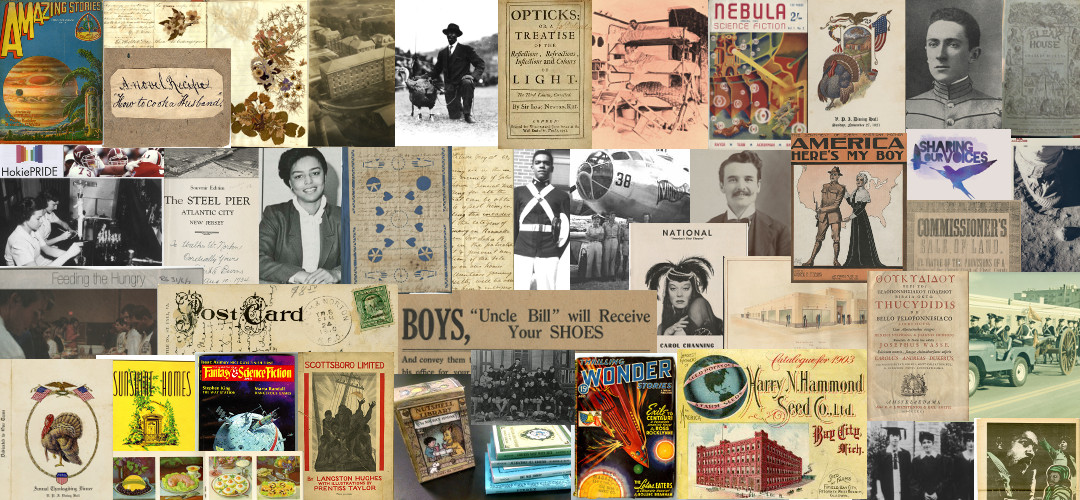
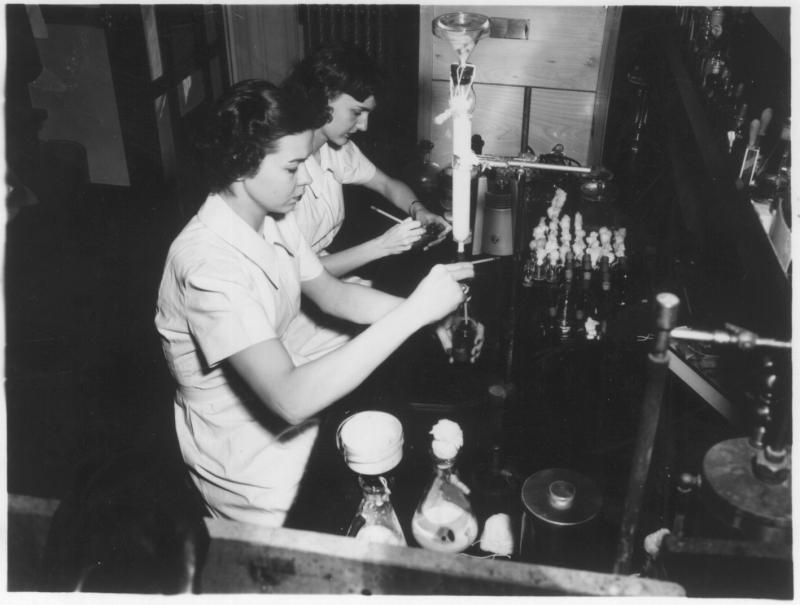
To celebrate womens history month, we are highlighting a small selection of the pioneering women professionals in our collections. These particular women entered their respective careers in the 1950s and 60s, a time when women had limited access to higher education and professional opportunities. Women in historically marginalized groups (including LGBTQ communities, rural communities, and communities of color) faced additional challenges beyond gender barriers. The four women profiled below overcame several obstacles to work as accomplished professionals in fields traditionally dominated by men.
VPI students Caroline Turner and Harriet Shelton at work in a chemistry lab, January 1950
Marjorie Townsend was named ” Townsend Knight of the Italian Republic Order” in 1972 for her contributions to US-Italian space efforts
In 1951, Marjorie Rhodes Townsend became the first woman to earn an engineering degree at George Washington University. One of few women in a traditionally male-dominated field, Townsend experienced significant discrimination from both coworkers and managers. In spite of these challenges, she enjoyed a lengthy and distinguished career at the forefront of aerospace technology. Townsend spent eight years with the Naval Research Laboratory developing sonar signal-processing devices for anti-submarine warfare. Townsend went on to work for the National Aeronautics and Space Administrations Goddard Space Flight Center from 1959-1980. As a project manager for NASAs Small Astronomy Satellite (SAS) program, Townsend helped coordinate some of the earliest advances in satellite technology and spacecraft systems design.
As an eighth-grade student, L. Jane Hastings was told that women could not be architects. When she secured a coveted spot in the University of Washingtons architecture program, Hastings recalls being asked to give up her place to make room for returning veterans. Hastings received her Bachelor of Architecture degree with honors in 1952, having worked full-time throughout most of her program. In 1953, she became the eighth licensed woman architect in the State of Washington. Hastings founded her own practice in 1959 and went on to form the Hastings Group, a prestigious firm that completed over 500 residential, commercial, and university projects across the greater Seattle area. In addition to practicing and teaching architectural design, Hastings was active in several professional organizations. In 1992, Hastings was appointed the first woman chancellor in the American Institute of Architects College of Fellows.
Learn more about the L. Jane Hastings Architectural Papers here:
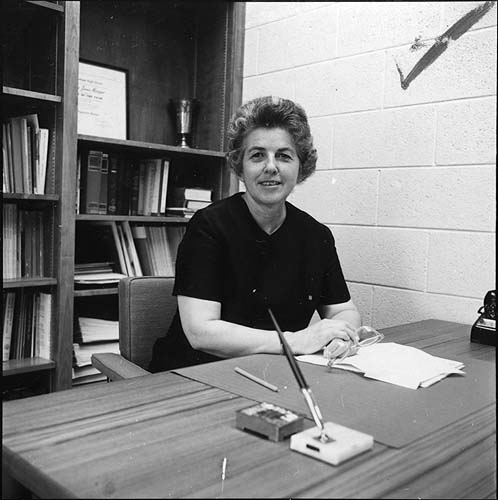
Dr. Laura Harper, dean of the Virginia Tech College of Home Economics from 1960-1980
Dr. Laura Jane Harper was the first woman to serve as an academic dean at VPI. She lead the College of Home Economics from 1960-1980, chartering a new program that emerged from the consolidation of the Home Economics programs at VPI and Radford University. Dr. Harper was lauded for mentoring other women and supporting them in leadership positions throughout the university. In her 1999 Masters thesis A Fighter To The End: The Remarkable Life and Career Of Laura Jane Harper, Saranette Miles recounted Dr. Harpers decision to turn down a marriage proposal for the sake of her career (p. 55) and how she frequently challenged VPI President T. Marshall Hahn to uphold his commitments to create meaningful opportunities for women at the university (p. 70-75) .
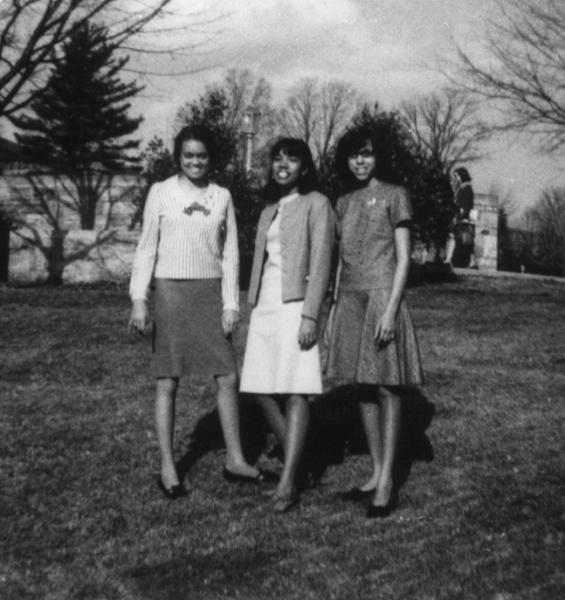
Chiquita Hudson, Marguerite Laurette Scott, and Linda Adams Hoyle, right, were among the first black women to attend Virginia Tech.
Linda Adams Hoyle (class of 68) was the first black woman to graduate from Virginia Tech. As a statistics major, Hoyle was frequently the only woman in her classes and one of few black students. Her experiences on campus – friendships, dorms assignments, political activism, and safety concerns – were shaped by the intersection of race and gender. After graduation, Hoyle went on to work as a statistician for the Census Bureau in Washington, D.C.In her oral history interview for the Black Women At Virginia Tech History Project, Hoyle discussed the challenges of raising a family while pursuing a career:
.. So when you have this full time career–my job at that time was extremely demanding. It was difficult because I had to attend to my children as well as do the job.My husband, the way he worked, it was difficult. He could not just stop in the middle of a job say to pick up a sick child. His work did not permit him that flexibility. Those were things I had to do.
This week I wanted to share a small collection of panoramic photographs that were taken of various locations around the Virginia Tech campus back in 1995 (and a couple from 2000). The photographs were made by University Relations, and although they were taken recently (well, relative to most of our collections!) they were still captured non-digitally on film and given to us as oversized 2.5″ X 16″ photographic prints. Seeing a flat 360 degree view is one thing, but once we scanned them and installed a panoramic viewer on our Special Collections Online site, they really came to life in a very immersive way. You can see the above picture of the Duck Pond with the viewer here.
Spring Graduation at Lane Stadium, 1995
Most of the photos will look pretty familiar, with one noticeable difference being the smaller stands in Lane Stadium with roughly 15,000 less seats. You can immerse yourself in the 1995 Spring Commencement ceremony here. Another would be the absence of Torgersen Bridge behind the Pylons in this view of the Drill Field. Torgersen Hall and the bridge over Alumni Mall were not completed until 2000.
You can see all the panoramic photos in this collection here.
This past Monday, a new exhibit opened on the 2nd floor of Newman Library. If you’re in the area over the next month or so, you might want to drop by! “Lincoln in Our Time” is an exhibit that includes documents, artifacts, pictures, and an interactive display with videos and presentations. Many of the materials on display come from Special Collections, and the videos are the work of a class in the Department of History, HIST2984: Abraham Lincoln: The Man, the Myth, the Legend.” You can read a bit about the exhibit in one of the photos below, but you’ll have to visit the library for more details. “Lincoln in Our Time” will be in place until April 15, so you’ve got plenty of time!
Lincoln in Our Time Exhibit
Lincoln in Our Time Exhibit. The TV on the right has interactive displays and videos.
Lincoln in Our Time Exhibit
Political cartoons and newspapers/magazine images
One of the display cases, including pictures, document, and artifacts from Special Collections.
Lincoln in Our Time Exhibit poster and “Our American Cousin flyer. The 7 foot tall version of the flyer was made from a scan of an item in Special Collections.
*Special thanks to Scott Fralin in University Libraries for the great photographs!
If “Lincoln in Our Time” isn’t enough Civil War history for you, you should also know about the upcoming Civil War Weekend on March 13-15, 2015. There will be guest speakers on a range of topics, showcasing Civil War history at Virginia Tech and beyond. Special Collections’ own Marc Brodsky, Public Services and Reference Archivist, will be talking about resources you can find here in our department. You can find out more about the events and register on the website!
Marking the 100th Anniversary of D. W. Griffiths Controversial Landmark Film, The Birth of a Nation
While recently pulling materials for an exhibit on silent films, I happened upon a small promotional flyer, probably from Blacksburgs Lyric Theatre, for D. W. Griffiths Birth of a Nation, which saw its initial theatrical release on March 3, 1915.
Though Griffith’s work is considered a watershed in cinematic history, few today can claim to have watched it in its entirety. The films relegation to a remote corner of public consciousness can be attributed to its silent film format (considered quaint or boring by most modern viewers) and to its treatment of a subject matter that is today widely seen as repugnant.
The Birth of a Nation purports to tell the story of Americas Civil War and the origin of the Ku Klux Klan during Reconstruction. In doing so, the film portrays the Klan as a noble organization devoted to protecting Southern society from marauding bands of brutish, lecherous Freedmen and their manipulative, hypocritical carpetbagger allies.
The Birth of a Nation flyer cover, depicting a cross-wielding Klan member in full regalia sitting astride a rearing horse, hints strongly at the films content and point of view.
The plot for The Birth of a Nation was based on Thomas F. Dixon Jr.s novel The Clansman, the second volume in a trilogy about the Reconstruction South. A North Carolina Baptist minister, attorney, and state legislator, Dixon became a popular author around the turn of the 20th century, publishing more than 20 novels. The Clansman
The Clansman is among five of Dixons novels held by Special Collections. The librarys main collection holds several more titles.
is today remembered as his most famous (or infamous) work, and from it was drawn the films Southern apologist version of the Klans origins.
In bringing Dixons tale to the screen, Griffith spared no expense and pioneered a number of moviemaking techniques and technologies: The Birth of a Nation is said to have been the first film to employ night photography, panning motion shots, the iris effect, the intercutting of parallel action sequences, and many more advances that would become mainstays of cinematic narrative. Griffith also employed hundreds of extras in staging epic Civil War battle scenes and interspersed his story with accurate tableaux of scenes from American history. The film was unlike anything that movie-going audiences had seen to that time.
Inside, the flyer lists some of the innovations and enormous costs associated with the films production.
Griffiths accuracy and attention to detail exploited the publics willingness to take its history lessons from fictionalized accounts. An uninformed audience, seeing accurately portrayed historical scenes presented side-by-side with Dixons skewed view of events, might be partially forgiven for accepting all as fact. Even supposedly knowledgeable viewers, however, were enthralled by Griffiths prowess as a storyteller. The film is said to have been the first to be screened in the White House. After seeing it, President Wilson, himself a historian, reportedly said, It is like writing history with lightning. And my only regret is that it is all so terribly true. The films widespread popularity and its audience’s impressionability are credited with being partially responsible for the KKKs resurgence and rise to political prominence during the 1910s and 1920s.
A page from the flyer illustrates how The Birth of a Nation mixed accurate historical depictions of the Civil War with with a subjective, fanciful interpretation of events.
Even in 1915, however, the film spurred controversy. The NAACP staged protests in several major cities and made repeated efforts to have the film banned from theaters. Letter-writing campaigns sought to educate the public on the facts of Reconstruction and to warn of the films inflammatory nature, while boycotts attempted to provide economic deterrents against the film’s release. Such efforts were in fact successful in having the film banned from the theatres of a handful of large cities but could not prevent its nationwide release.
Testimony to its immense popularity at the time, The Birth of a Nation continued to enjoy periodic revivals for years, and it is said to have remained Americas highest-grossing film until being toppled by another Civil War / Reconstruction epic, Gone with the Wind, more than twenty years later.
Despite his films overwhelming commercial success, Griffith was not immune to criticism. Partially in response to negative comments on his films racially intolerant themes, Griffith released his magnum opus, Intolerance, the following year. The three-and-a-half hour epic tells four parallel stories from different time periods of human history, each illustrating the catastrophic consequences of intolerance. Griffith would continue to make films throughout the silent era with varying degrees of success, but he never again matched the achievements of The Birth of a Nation and Intolerance.
Special Collections holds flyers for at least two of Griffith’s many other feature films.
Special Collections holds flyers for at least two of Griffith’s many other feature films.
Should The Birth of a Nation be considered an early cinematic masterpiece that is marred by its skewed interpretation of history and its outdated, hateful view of racial relations, or should any film (or other work of art) be considered a masterpiece when it advocates a point of view that is later almost universally abhorred as destructive and wrongheaded? In answering this question in his 2003 review of the film in 2003, critic Roger Ebert wrote: The Birth of a Nation is not a bad film because it argues for evil… [I]t is a great film that argues for evil. To understand how it does so is to learn a great deal about film, and even something about evil.
Portrait of Dr. John Redd Hutcheson, circa 1940s, from the John R. Hutcheson Family Collection, Ms2015-001
Recently, Special Collections received a new collection, the John R. Hutcheson Family Collection, containing letters, newspaper clippings, photographs, and more documenting the life of Virginia Tech president John R. Hutcheson.
Although only president of Virginia Polytechnic Institute (VPI, as Virginia Tech was then known) for two years from 1945 to 1947, John Redd Hutcheson (1886-1962) devoted himself to serving his alma mater and the people of Virginia. He enrolled at VPI in 1903 at the behest of his brother Tom. In order to pay for college, the brothers lived in the dairy barn on the college farm, where they milked 17 cows a night for 8 cents an hour each (roughly $2.15 an hour in 2015!) After saving his earnings, Hutcheson moved into the barracks and then waited tables in the school dining hall. He received a bachelor’s degree in 1907 and master’s in 1909.
Following several years teaching high school in Virginia and Mississippi, Hutcheson received a letter from Joseph D. Eggleston, VPI president and director of the Virginia Agricultural Extension Service (now Virginia Cooperative Extension), urging Hutcheson to join his staff. He accepted, becoming an animal husbandry specialist in 1914. In 1917, Hutcheson was appointed assistant director and two years later succeeded Eggleston as director of the Extension. Over the next 25 years, Hutcheson helped to organize the Virginia Farm Bureau and Virginia Agricultural Conference Board, to reestablish the Virginia State Grange, and to develop a long-range program for developing the state’s agriculture. All of his work developing the farm and home demonstration program in Virginia earned Hutcheson an honorary doctorate from Clemson University in 1937, along with his brother Tom, VPI professor T.B. Hutcheson.
Article entitled “Clemson’s First Honorary Degrees Go to Hutcheson Brothers of V.P.I.”, about John R. and T.B. Hutcheson, May 12, 1937, from the John R. Hutcheson Family Collection, Ms2015-001
In 1944, the Board of Visitors appointed Dr. Jack (as Hutcheson was affectionately known) acting president of VPI, and the next year he succeeded Dr. Julian A. Burruss as the ninth president. During his tenure, the student population swelled following the end of World War II, and he was responsible for making accommodations for the new civilian population (made up almost entirely of veterans), who outnumbered the cadet students for the first time in VPI’s history. Temporary trailer courts were established on campus to house the veterans, and Dr. Jack would personally visit them to ensure they had fuel for their homes.
Article discusses the nomination of John R. Hutcheson as V.P.I. president, Roanoke Times, August 15, 1945, from the John R. Hutcheson Family Collection, Ms2015-001
The enormity of his duties necessitated the creation new executive positions during Dr. Hutcheson’s presidency. He created the office of admissions, director of student affairs, director of buildings and grounds, and a university business manager position. The Board of Visitors, at Dr. Jack’s suggestion, appointed Walter S. Newman as the university’s first vice president – all within two years!
Page 2 of obituary for John R. Hutcheson, [January 1962], from the John R. Hutcheson Family Collection, Ms2015-001 Page 1 of obituary for John R. Hutcheson, [January 1962], from the John R. Hutcheson Family Collection, Ms2015-001Unfortunately, just 16 months into his presidency, Hutcheson entered the hospital and had to take sick leave. Newman became acting president until Sept. 1947, when he succeeded Hutcheson. Simultaneously, the Board of Visitors elected Dr. Jack as the first chancellor of Virginia Polytechnic Institute and the next year named him the first president of the newly formed VPI Educational Foundation, Inc. (now the Virginia Tech Foundation, Inc.) Dr. Jack remained chancellor until 1956 and president of the foundation until his death in 1962.
The legacy of Dr. Hutcheson’s tenure at Virginia Tech is still visible today from the continuing work of the Virginia Cooperative Extension to the numerous offices he created still operating. And of course, you can visit Hutcheson Hall on the Blacksburg Campus, dedicated to John R. and T. B. Hutcheson in 1956.
When I arrived in fall of 2014 as a new employee, the department had an exhibit on display featuring miniature books from the 19th and 20th centuries. It was a perfect introduction to the curious, strange, and unexpected variety of materials that I would come to find in Special Collections.
The Library of Congress defines miniature books as works 10 centimeters or less in both height and width, which is a little under 4 inches. The Miniature Book Society maintains a more circumscribed definition of no more than three inches in height, width, or thickness. Within these parameters, American collectors recognize several sub-categories, including macro-mini (3-4), miniature (2-3), micro-mini (1-2), and ultra-micro-mini (less than 1). Often intricately bound and printed, miniature books are considered a testimony to the printers skill.
One of our miniature books, an early 19th century devotional entitled Dew Drops, is about the size of a house key.
According to the American Antiquarian Society, the oldest miniature books were produced on clay tablets in Mesopotamia; scholars and monks from ancient Egypt to medieval Europe produced miniature manuscripts by hand long before the invention of the printing press. The Diurnale Mogantinum, published in 1468 by Johann Guttenbergs assistant Peter Schoffer, is the earliest example of a traditionally printed miniature book. The tiny texts became particularly fashionable in America during the 19th century as a portable and novel way to carry decorative and instructional texts. The most popular books in this time were religious tracts, advertisements, and childrens books.
“Imitacin De Cristo.” This 1964 text, which measures a little under 3.5 inches long, is ornately bound in gilded leather.
Miniature books experienced a new wave of popularity in the 1970s as artists and independent publishers explored new methods for binding, printing, and distributing. Like their full-sized counterparts, modern miniature books are incredibly diverse in construction and purpose, ranging from plain and conventionally bound to elaborately illustrated pop ups, scrolls, and accordions.
Maurice Sendaks Nutshell Library, a collection of children’s stories.
Although Special Collectionsdoes not collect tiny books on the scale of some passionate hobbyists, we have accumulated a limited but fascinating assortment of miniatures over the years. Highlights include an ornithology text published in 1810; several 19th and 20th century childrens books; a collection of Lincoln speeches reprinted in the mid 20th century; curios, art books, and poetry chapbooks by American micro-presses in the 1960s and 1970s; a handful of foreign language texts; and an edition of Five Articles by Chairman Mao Tse-Tung.
A simply but beautifully bound chapbook by master printing James WeilPublished in 1972 by Peking Foreign Languages Press, this edition is bound in red plastic.






!["Dr. John R. Hutcheson Named President of Virginia [Polytechnic Institute]"](https://i0.wp.com/scuablog.lib.vt.edu/wp-content/uploads/2015/02/hutcheson_president.jpg?ssl=1)
![Page 2 of obituary for John R. Hutcheson, [January 1962], from the John R. Hutcheson Family Collection, Ms2015-001](https://i0.wp.com/scuablog.lib.vt.edu/wp-content/uploads/2015/02/hutcheson_obit_02.jpg?ssl=1)


