Recently added online are a collection of illustrations by Lucy Herndon Crockett, a successful author and illustrator from Southwest Virginias Smyth county. Lucy authored nine books during her lifetime, the most well-known being The Magnificent Bastards in 1954, about her experiences with the U.S. Marine Corps in the South Pacific during World War II. In 1956, it was adapted by Paramount Pictures into an Oscar-nominated film The Proud and the Profane, starring Deborah Kerr and William Holden. In addition to her writing career, Lucy lead a very interesting life.
Movie Poster from Paramount Pictures’ ‘The Proud and the Profane,’ 1956, adapted from Crockett’s book ‘The Magnificent Bastards’
Born in Honolulu, Hawaii in 1914, Lucy spent most of her childhood on various military bases around the world, including Venezuela and Switzerland. After high school, she accompanied her father while he served as advisor to Governor General Theodore Roosevelt, Jr., who was overseeing both Puerto Rico and the Philippine Islands. During World War II, she served a five year tour of duty with the Red Cross in New Caledonia, Guadalcanal, the Philippines, Japan and Korea.
It was this time period that inspired much of the material for her books, including Teru: A Tale of Yokohama, for which we have the original illustrations. Her passionate personality and strong sense of duty comes through in many of her characters. Interviewers described Lucy as a lady who seemed too gentle for the ugliness she described in her writings. In her book The Magnificent Bastards, she said The theme of my book actually is how each person has a breaking point, and if you are lucky in life you are not put to it. In my book I say it is frightening how we can never anticipate how we will react under strain, and my book is about strain. When asked why she got into the war, she said that war, horrible as it is, is an experience that some people cannot resist participating in if they possibly can. With me, I am sure a sense of duty is wrapped up in it.
Illustration from Terru: A Tale of Yokohama
In 1947, Lucy retired from the Red Cross and settled in Southwest Virginia. Her creative pursuits, many travels and strong opinions made Lucy a well-known eccentric character in Seven Mile Ford, where she lived most of her adult life in a historic 22-room house called The Ford. Alongside her mother Nell, Lucy ran a gift shop out of the house called The Wilderness Road Trading Post. The shop featured her books, illustrations, paintings, decoupage and hand-hooked rugs. She designed the rug patterns which were then executed by local craftsmen.
Illustration from Terru: A Tale of Yokohama
Over the years, Lucy became increasingly eccentric and paranoid of those around her; at one point, threatening behavior toward then President John Kennedy led to a period of house arrest. She was known to write many letters to local newspaper editors. One of Lucys most interesting letters detailed her objection to a landfill being built just north of Seven Mile Ford, near the Middle Fork of the Holston River. She described county officials as displaying an ape-like display of leadership genius in proposing to turn this heavenly segment of landscape into a dump. She argued that the site instead be turned into a resort that would attract tourists. She even suggested a name the project-Cayetana, after a friend of hers, Cayetana Alba, the Duchess of Alba, grandee of Spain. According to Lucy, the Duchess and her friends were enthusiastically prepared to sponsor this project.
Lucy Herndon Crockett died in 2002. The closing paragraph of her obituary best describes her character. She always had people who were willing to try to help her. Perhaps they were drawn to her complex personality, her prominent possessions or her seeming helplessness. A caregiver who may have known her best at the end of her life described her as kind, loving, generous, selfish, fearful, distrusting and confused. Ironically, these are the same universal emotions which she so skillfully wove into her characters in her best known book, The Magnificent Bastards.
German language poster: Freiheit für [Freedom for] Angela Davis, c. 1971-72
Many times over the course of this blog either I or one of my colleagues has written about an aspect of the job of being an archivist that can best be described as “discovery.” Typically, we find something we’ve never seen before, didn’t know about, or never heard of. Sometimes, it’s finding out that several of those Eudora Welty editions that you’ve walked by hundreds of times are signed by the author. Or—as mentioned in a recent post by one of our student workers—discovering in a newly acquired collection that some number of rodents had a fondness for those hundred year-old letters . . . a fondness for eating them or living in them. Not long ago, I came across a letter in which a sitting president of this university turned down an offer to become president of the University of Virginia. I’m sure someone knew about that, but I didn’t. On and on. Surely, it’s one of the most interesting aspects of working in the archives.
Sometimes the discovery is both significant and puzzling. No, not significant in the way that an original letter by Ralph Waldo Emerson was found in a Brown University library book as it was about to be checked out in 2015. And perhaps we shouldn’t be puzzled when a quick google search on combined terms such as “found letter library” turn up instances of letters by Orson Welles, Robert E. Lee, Napoleon, Walt Whitman, Jack London, Thomas Jefferson, and Robert the Bruce, among others, all being found in unexpected places in libraries in recent years.
Even so, it was surprising, if not a bit mysterious, when, several years ago, an entire collection of pamphlets—ten cubic feet of pamphlets and other publications from the 1920s through the early 1970s—mostly having to do with African American politics and history, but also with Africa, the West Indies, Asia, and the Communist Party of the United States, was “found” in a Special Collections storage area. At that time, our staff had increased sufficiently to be able to begin to process the unprocessed or minimally processed “hidden collections” we expected to find there. Also, the space needed to be reclaimed for more active purposes. The materials were in folders labeled by section and most of the pieces had an adhesive label that named the section and numbered the item, the labeling bit being a very un-archivist-like action!
Right there in the upper right-hand corner, for example, is a sticker that reads, “Black Panther Party no.13” on a booklet titled, Here and Now for Bobby Seale: Essays by Jean Genet. The back cover has a New York phone number and the name of the Committee to Defend the Panthers. There is no date on the publication, but it is a reprint of articles published in the June 1970 issue of Ramparts. In the essays, Genet presents his appeal to defend Seale against murder charges in New Haven. The booklet concludes by presenting the Panther platform and program and offering subscriptions to the Black Panther Party Black Community News Service. Here are a few other examples from this part of the collection:
Bail for Angela Davis, New York Committee to Free Angela Davis, c. 1971
Black Man’s Stake in Vietnam, Black Panther Party, undated
Toward Black Liberation – Stokely Carmichael, 1966
Dixie Comes To New York<, Story of the Freeport GI Slayings, Harry Raymond, 1946
Hell in Georgia, What Angelo Herndon Faces, Sasha Small, 1935
Huey Newton Talks to the Movement, SDS, Students for a Democratic Society, undated
The New Crisis in Civil Rights, Bayard Rustin, 1966
They Shall Not Die! Stop the Legal Lynching: The Story of Scottsboro in Pictures, League of Struggle for Negro Rights, 1932
Black Power in Britain, Universal Coloured People’s Association, undated
Holmes County, Mississippi: We Are the Majority Race, Holmes County Freedom Democratic Party, 1967
Jim Crow Murder of Mr. and Mrs. Harry T. Moore: New Dangers and New Tasks Facing the Negro Struggle, George Breitman, 1952
A full list of these publications can be viewed in the finding aid for the collection. In addition to “Black Panther Party,” you’ll see section titles that designate a wide variety of subjects, including: Black Power, Black Nationalism, ACLU, Arts, Brownsville TX, Church, Civil Rights, Discrimination, Convict Labor, Communism, Courts, Education, Music, Lynching, NAACP, Propaganda-Communist, Prisons, Race Problems, South, and many others. The African American material accounts for about half the collection. The material related to Africa, about a quarter of the collection, similarly, represents a wide range of topics, from Apartheid, Algeria, Britain in Africa and Burundi to Uganda and Zambia. The Caribbean material is grouped, first, by country or island, and then by social and/or political issue, with topics such as Trade Unions, Revolution, Industrialization, and People’s National Movement represented. Another box contains about 60 publications grouped simply under the title, “Communism.” These tend to share in the radical/leftist perspective of many of the others—though not exclusively—but have little or nothing to do with Black America or Africa. Pamphlets on the case of Julius and Ethel Rosenberg or the House Un-American Activities Committee are present alongside more Soviet-related matters, such as Trotsky as counter-revolutionary or the assassination of Sergei Kirov. Here are some examples from these areas:
The Assassination of Kirov: Proletarian Justice versus White Guard Terror , M. Katz, 1935
To Defend Assassins Is to Help Fascism, George Dimitroff, 1937
I Challenge the Un-Americans, Eugene Dennis, c.1947
To Secure Justice in the Rosenberg Case, William A. Reuben, c.1951
The Plot to Gag America, Elizabeth Gurley Flynn, 1950
African Challenge: The Story of the British in Tropical Africa, British Information Services, 1945
Anniversary of the Death of Josina Machel, undated [post-1971]
Education for Apartheid, Brian Bunting, undated
War in Africa: Italian Fascism Prpares to Enslave Ethiopia, James W. Ford and Harry Gannes, 1935
Declaration of Havana, Fidel Castro, 1960
Marines in Santo Domingo, Victor Perlo, 1965
Rules of the Barbados Progressive League Friendly Society, 1940
Trotskyism and the Cuban Revolution: An Answer to Hoy, Joseph Hansen, 1962
So, what was this extremely rich collection doing in a storage area? How long had it been there? How had the collection been used in the past. How did it get here? When? Who put those labels on the individual items? We started using the collection almost immediately, even before we wrote the finding aid, mostly in conjunction with classes that came to Special Collections for instruction, but the questions remained. I wondered if it had been brought in decades ago as a general collection for the library, not by Special Collections, perhaps made available and then put away for some reason and largely forgotten. Maybe too much radical material? And there was just the nagging impression that the collection had not been processed the way any self-respecting archivist would have done. Yet it had been foldered, even though some of the classifications were odd and then there were those #$@*&! stickers!
Two of the largest sections—series, as they are properly called—are titled, Discrimination and Negroes. (The latter, especially, may suggest a clue as to when the collection arrived.) Here, too, broad ranges of topics are covered, but often overlapping with other series. There are materials, for example, on discrimination in housing and employment, in the military, and with regard to voting and transportation. As in the rest of the collection, there are original pamphlets; also reprints of articles from publications as diverse as the New York Times, Atlanta University Review of Race and Culture, and Political Affairs. There’s a typed November 1929 release from the Negro Labor News Service and an article clipped from the April 1944 issue of Spotlight written by Adam Clayton Powell while he was first running for a seat in the U.S. House of Representatives. Here’s a view of some of the pieces in these series:
Behind the Lynching of Emmet Louis Till, Louis Burnham, December 1955
Agents of Peace, Albert E. Kahn, undated, c.1951
The Communist Conspiracy Against the Negroes, George S. Schuyler, 1947
An End to the Neglect of the Problems of the Negro Woman, Claudia Jones, c.1949
Black Women’s Liberation, Maxine Williams and Pamela Newman, 1971
Let Us Build A National Negro Congress, John P. Davis, 1935
Black Marines Against the Brass, American Servicemen’s Union, September 1969
Jim-Crow in Uniform, Claudia Jones, 1940
Henry Ford and the Negro People, Christopher C. Alston, undated, c.1941
Jim Crow “Justice” in Korea: The Case of Lieutenant Leon Gilbert, undated, c.1950
The Killing of William Milton, Art Shields, 1948
Let Freedom Ride the Rails, National Negro Labor Council, undated, c.1953
A Petition to the United Nations on behalf of 13 million oppressed Negro citizens of the United States of America, National Negro Congress, 1946
Our Negro Veterans, Charles G. Bolte and Louis Harris, 1947
Negroes in the Post-War World, Albert Parker, 1943
I Was a Negro In the South for 30 Days, Ray Sprigle, Pittsburgh Post-Gazette, 1948
Side By Side, United Electrical, Radio and Machine Workers of America, undated
When Will It End, Frank R. Crosswaith, Negro Labor News Service, 30 November 1939
Lift Every Voice for Victory, Claudia Jones, 1942
Political Biography of Angela Davis, NY Committee to Free Angela Davis, January 1971
A Big Stride Forward, Rev. A. Clayton Powell, “Spotlight,” April 1944
You Cannot Kill the Working Class, Angelo Herndon, undated
What’s Next for Richard Wright, Constance Webb, 1949
Racial Terror at Trumbull Park, Chicago, Howard Mayhew, 1954
Sit-Ins: The Students Report, Congress of Racial Equality (Core), 1960
The Unconstitutionality of the 14th Amendment, Sons of Liberty, undated, c.1966
The U.S. Negro in Vietnam: A Series by Thomas A. Johnson, New York Times, 1968
Yes, that’s Joe Louis with the rifle and bayonet. If you look through the galleries above, you’ll get a sense of just how rich this collection is. There are even some right-wing pamphlets thrown in, like the one that declares the 14th amendment unconstitutional or one from Christian Crusade Publications that proclaims, “The Black Panthers Are Not Black . . . They Are Red!”
But to get back to the mystery, it appears that the collection arrived sometime by April 1974. We found a memo dated 4 April 1974 (we are the Archives, after all) that reads:
Pamphlet files on Afro-American Studies, Communism, and Viet-Nam
Each of these files has its own set of catalog cards in Spec—shelf, author, title and subject, prepared by a cataloger who worked in Spec for this project only. Mr. Bechanan is considering what should be in the Main catalog referring patrons to these files.
H. Gordon Bechanan was Assistant Director of Newman Libraries from 1972 to 1974, when he was made Director. He served in that capacity until 1984. The reference to the collection as a project does suggest that the collection was brought in—undoubtedly, purchased—as a complete entity. The Library did not assemble this collection itself. Most likely, those stickers and the designation by subject was done by the dealer from whom the collection was purchased. (Again, no archivist worth his or her salt . . . never mind.)
As for the efforts of the cataloger and those shelf cards, we found them, too. How they might have been used is anyone’s guess, but the information on them was apparently not transferred to the library’s online catalog when the card catalog system was replaced. I’ve heard that the collection may have been purchased in response to a suggestion or expectation that an African American studies program or department would be formed on campus, but that didn’t happen here in the 1970s. So, as is sometimes the case, maybe there are other records not yet found or maybe, as was true of Special Collections in those years, record-keeping may not have been nearly as complete as it is today. But the answer to the question of how this collection ended up in a storage room remains uncertain.
What is certain is that this is a fabulous collection. As someone who cares deeply about primary source research, I know there are countless questions for which this material will provide a step or several steps along somebody’s research path. Do you know who Angela Davis is, or why there were calls for her to be freed? (She did speak briefly at the Womens March in Washington the day after the inauguration last January.) Why do we have several pieces about her in German? Who was Lieutenant Leon Gilbert or Harry T. Moore or William Milton? We know about Emmett Till, but have you looked at any sources from time of his tragic death? This blog offered a post about the Scottboro trials and, specifically, Langston’s Hughes’s relation to that situation, but did you know about the Freeport GI slayings in 1946? I didn’t until I looked at “Dixie Comes to New York,” one of the pamphlets in the collection.
Once lost, but then found, the Black History Pamphlet Collection provides an important gateway to understanding, a route to discovery and rediscovery. We have kept the classifications as they are, even though they may be inaccurate and, at times, anachronistic, in keeping with the imperative to respect the original order of the collection. In other words, we’re treating the collection as a cultural and documentary artifact itself. And although most of our digitization efforts focus on unpublished sources—because they are truly unique—Special Collections is considering this collection as a candidate for such an effort. We need to find out just how many of these pamphlets are held elsewhere and how many may already be available online, but the importance of the collection is undeniable. At any rate, for those folks in the area or those who can travel to Blacksburg, it presents significant opportunities for reading and study. Come visit Special Collections!
As part of Virginia Techs annual observance of its Day of Remembrance, condolence items and artifacts received by the university in the days that followed April 16, 2007, will be displayed at several locations across campus. The displays are among several “Expressions of Remembrance” that will be located in Newman Library, Squires Student Center, Moss Arts Center, and Holtzman Alumni Center; they are free and open to the public.
Each year, in observance of the Day of Remembrance, University Libraries at Virginia Tech displays materials from the April 16 Condolence Archives and invites the community to reflect and remember.
Below is a list and photos of exhibits all around campus. For more on each, please see the press release and the We Remember website.
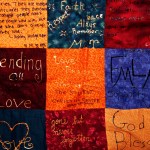
Sending You All Our Love
The exhibit will include materials received from other colleges and universities, as well as some of the large white boards and signs created on the Drillfield the week of April 16, 2007. Additional items include flags, t-shirts, and condolence books, and a quilt from the Feminist Majority Leadership Alliance at State University of New York College at New Paltz. The exhibit title came from one of the quilt squares, each of which was made by a SUNY student.
This display can be seen April 8-16 in the Old Dominion Ball Room in Squires Student Center.
April 16th 2017 exhibit in Squires
April 16th 2017 exhibit in Squires
April 16th 2017 exhibit in Squires
April 16th 2017 exhibit in Squires
April 16th 2017 exhibit in Squires
April 16th 2017 exhibit in Squires
Remembering Those Lost
Artifacts include flags flown over the Statue of Liberty and at Tikrit Air Academy in Iraq by soldiers during Operation Iraqi Freedom; Farham Aboussalis painting Ceremonial Eternity; Carol Davis 32 hand-decorated eggs; Marilyn Rogges painting of a child releasing a red balloon; a KoKeshi Doll from the U.S. Navy Fleet Activities, Yokosuka, Japan; and some of the paper cranes received.
This display will be held April 8-16 at Newman Library Special Collections (first floor). Part of the exhibit is in the windows of Special Collections onto the cafe, open during library hours. A second portion of the exhibit is inside Special Collections, open Monday-Friday, 8am-5pm.
April 16th 2017 exhibit in Special Collections
Selections from April 16th 2017 exhibit in Special Collections
Selections from April 16th 2017 exhibit in Special Collections
Selections from April 16th 2017 exhibit in Special Collections
April 16th 2017 exhibit in Special Collections
Mourning cloth for Partahi Mamora Halomoan Lumbantoruan, who worked in Newman Library while studying at Virginia Tech
A Community of Learners, a Legacy of Achievement
A selection of books will be displayed to honor of the students and faculty lost on April 16, 2007.
This display will be held April 8-16 at Newman Library Learning Commons.
April 16th 2017 exhibit in Newman Library
April 16th 2017 exhibit in Newman Library
Partahi Mamora Halomoan Lumbantoruan, who worked in Newman Library while studying at Virginia Tech
Communities of Caring
A digital exhibit featuring community expressions of support from the April 16 Condolence Archives.
Communities of Caring April 16th 2017 digital exhibit
April 16 Condolence Archive display
Items include cards and letters written to police and first responders; a display of the badges of police units who came to help Virginia Tech; Cheryl Thompsons painting, Remember the 32; condolence books; quilted squares from Union Village United Methodist Church; black marble laserworks by David Cunningham, and April 17th Hokies United by Miss Prices second grade class from Riverlawn Elementary, Fairlawn, Virginia.
This display will be held April 12-May 3 at the Holtzman Alumni Center.
Passages
A quiet, contemplative space for remembrance and reflection, this display will include prayer flags from the Virginia Tech Graduate Arts Council, Hillel, Living Buddhism, and Unitarian Universalist Congregation of the New River Valley and photographs from the community.
This display will be held April 12-16 at the Miles C. Horton Jr. Gallery and Sherwood P. Quillen 71 Reception Gallery in Moss Arts Center.
 Recently added online are a collection of illustrations by Lucy Herndon Crockett, a successful author and illustrator from Southwest Virginias Smyth county. Lucy authored nine books during her lifetime, the most well-known being The Magnificent Bastards in 1954, about her experiences with the U.S. Marine Corps in the South Pacific during World War II. In 1956, it was adapted by Paramount Pictures into an Oscar-nominated film The Proud and the Profane, starring Deborah Kerr and William Holden. In addition to her writing career, Lucy lead a very interesting life.


![German Language poster: Freiheit für [Freedom for] Angela Davis, c. 1971-72 (front)](https://i0.wp.com/scuablog.lib.vt.edu/wp-content/uploads/2017/03/angeladavisfreiheit_front.jpg?resize=330%2C495&ssl=1)
![German Language poster: Freiheit für [Freedom for] Angela Davis, c. 1971-72 (back)](https://i0.wp.com/scuablog.lib.vt.edu/wp-content/uploads/2017/03/angeladavisfreiheit_back.jpg?resize=330%2C495&ssl=1)
 Here and Now for Bobby Seale: Essays by Jean Genet” width=”236″ height=”300″ class=”size-medium wp-image-5697″>


![Anniversary of the Death of Josina Machel, undated [post-1971]](https://i0.wp.com/scuablog.lib.vt.edu/wp-content/uploads/2017/04/anniversarydeathjosinamachel.jpg?resize=150%2C150&ssl=1)