The Wonderful Witches of Oz

As they passed the rows of houses they saw through the open doors that men were sweeping and dusting and washing dishes, while the women sat around in groups, gossiping and laughing.

What has happened? the Scarecrow asked a sad-looking man with a bushy beard, who wore an apron and was wheeling a baby carriage along the sidewalk.

Why, weve have a revolution, your Majesty as you ought to know very well, replied the man; and since you went away the women have been running things to suit themselves. Im glad you have decided to come back and restore order, for doing housework and minding the children is wearing out the strength of every man in the Emerald City.

Hm! said the Scarecrow, thoughtfully. If it is such hard work as you say, how did the women manage it so easily?

I really do not know, replied the man, with a deep sign. Perhaps the women are made of cast-iron.

-L. Frank Baum; The Marvelous Land of Oz

The patchwork girl of Oz  by L. Frank Baum; illustrated by John R. Neill (1913)
The patchwork girl of Oz by L. Frank Baum; illustrated by John R. Neill (1913)

The release of the blockbuster film Oz: The Great and Powerful earlier this month has sparked a renewed interest in the life and work of L. Frank Baum. Best known for his children’s masterpiece The Wonderful Wizard of Oz and the 1939 screen adaptation starring Judy Garland, Baum authored more than a dozen different novels set in the magical Land of Oz, which took its name from the bottom drawer of the file cabinet in Baums office, labeled for files beginning with the letters O-Z.

Of course Baum was much more than just a juvenile fiction author. As we celebrate women’s history month, it should be noted that the cause of women’s suffrage was supported and advanced byprominentmale figures of the era. Baum, who publicly lobbied for women’s right to vote and served as the secretary ofhis town’s Woman’s Suffrage Club, was deeply affected by his beloved, spirited wife, Maud, and her mother, Matilda, an eminent feminist who collaborated with Susan B. Anthony andpublicized the idea that many “witches” were really freethinking women ahead of their time. In Oz, Baum offers a similarly corrective vision: When Dorothy first meets a witch, the Witch of the North, she says, “I thought all witches were wicked.” “Oh, no, that is a great mistake,” replies the Witch of the North. In sequels, Oz’s true ruler is discovered; it turns out to be a girl named Ozma, who spent her youth under a spell – one that turned her into a hapless boy.

Baum’s contact with suffragists of his day seems to have inspired much of his second Oz story,The Marvelous Land of Oz. In this story, GeneralJinjurleads the girls and women of Oz, armed with knitting needles, in a revolt; they succeed, and make the men do the household chores. Jinjur proves to be an incompetent ruler, and a female who advocates gender equality is ultimately placed on the throne. His Edith Van Dyne stories, including theAunt Jane’s Nieces,The Flying Girland its sequel, and his girl sleuth Josie O’Gorman fromThe Bluebird Books, depict girls and young women engaging in traditionally masculine activities.

The Wonderful Wizard of Ozand its sequels were obviously shaped by Baums wishful revisions of social conflict and are now almost universally acknowledged to be some of the earliest feminist childrens books in America, because of Dorothy and similar characters: girls who are enterprising, ingenious, adventurous, or imposingly self-reliant.

Located within Special Collections at Virginia Tech are several Baum titles that can be found by searching the University’s online catalog, Addison. Among the results are two first editions: The Patchwork Girl of Oz (1913) and The Enchanted Island of Yew (1903). You are invited to visit us and examine these texts to discover more about the inspiring heroines of Oz.

Claiming What’s Hers: Repayment under Reconstruction

Continuing with our Women’s History Month features, this week we’re sharing a single post-Civil War document: A claim for damages filed in Lawrence County, Tennessee, in 1868. While the item itself may seem small, it had no small meaning to Elizabeth Hughes.

We can’t identify Elizabeth Hughes with 100% certainty, but the claim does give us some clues. We know where she lived during the war. (Lawrence County, TN, is located south and slightly west of Nashville, just on the Alabama border.) We know that she was born around 1818. Her husband, not named, enlisted in the Union army and was killed in service. And, judging by the spaces requiring a signature, she did not know how to write. Her name has been written around an “X,” indicating her mark.

However, these few tidbits can tell us a lot more about her. The U.S. Census in 1860 includes an Elizabeth Hughes who was born about 1817. She lived in a household with an “A W Hughes,” age 40, who we could guess is her husband. If so, they appear to have had five children. The National Part Service’s Civil War Soldiers and Sailors database includes only one Hughes with the initials “A W” who fought for the Union–Anderson W. (4th Tennessee Cavalry). Other genealogy records suggest they were born and married in Alabama, moving their family to Tennessee between 1847 and 1852.

On a side note, there are a few small changes on the claim, presumably made by the county clerk. Even though the form includes the phrases “he (or she)” and “man, (or woman,),” both the “he” and “man” have been crossed out. There’s no question about who this document represents.

The claim is one of many that would have been filed in states around the country following the Civil War, but it also tells an important chapter in one woman’s story. Elizabeth Hughes lost a great deal in a short period of time, including a husband and a household:

By the Burning of my House I lost all of my House hold. Kitchen Furnature Some valuable Papers and many other articles too tedious to mention Supposed to be worth about [1050.00] 6 Six Sides Leather Supposed to weigh about 18 pounds Each 108# at .50 cts per lb. 50 Bushels wheat @ $1.00 per Bushel 1 set wagon Harness for 2 Horses 1 Horse 5 Years old

She survived the war and was presumable compensated for her lost property (the claim was approved, according to the signatures on the last page). Nearly 150 years later, when this copy of her claim surfaced among unprocessed materials at Special Collections, this little piece of Elizabeth’s life gives us new insight into Reconstruction and to what it meant to be a woman reclaiming her household and identity in 1868.

A Mightier Ring: Bugle or Tin Horn?

Hokies know that each year their activities are chronicled with a Bugles call, but how many know that The Bugle, Virginia Tech’s yearbook, was once accompanied by a Tin Horn.

VT's First Women Graduates
The first women graduates of Virginia Tech were (l-r) Mary Brumfield, 1923. and Ruth Terrett, Lucy Lancaster, Louise Jacobs, and Carrie Sibold, 1925

Women were formally approved by the Virginia Agricultural and Mechanical College and Polytechnic Institutes Board of Visitors to be admitted to all courses of study excluding the military on January 13, 1921. This motion was approved, unanimously, due in large part, to VPI president, Julian A. Burruss persuasive arguments that VPI was in a unique position to economically provide the technical and agricultural training needed by Virginias women in the new arenas available to them in the post-World War I society.

Although, the motion to allow women to attend VPI was accepted unanimously by the Board acceptance among the cadets (and some professors) took a bit longer. The co-eds who arrived ready for classes in September 1921 faced cadets whopubliclyprotested their admission and professors who actively doubted the womens intelligence. Acceptance in extra-curricular activities was nonexistentso the co-eds organized their own groups: a basketball team (at various times called the Sextettes and the Turkey Hens); a Womens Student Organization; special science, chemistry, business, and biology clubs; the Coed Dramatics Club; and their own yearbook The Tin Horn.

The 1925 Tin Horn, published when the women who entered in 1921 would be seniors, consisted of hand-drawn pages and pasted-in photographs dedicated to the spirit of fun. Although, billed as the first and only volume, subsequent publications of The Tin Horn followed in 1929, 1930, and 1931. The latter two were professionally printed. It would not be until 1941, 20 years after the arrival of the first female students on campus, that The Bugle would represent women equally alongside the men in their pages.

Special Collections has digitized all four volumes of The Tin Horn. They have also been pulled as part of our celebration of Womens History Month and are available for viewing in our Reading Room. Whether you visit with The Tin Horn online or in Newman Library make sure to spend some time with Virginia Techs leading ladies.

Yours in Sisterhood: Special Collections Celebrates Womens History Month

Tin Horn 1925
Page from the 1925 self-published, co-ed yearbook The Tin Horn.

March is Womens History Month and in honor of this commemorative month Special Collections is hosting an interactive exhibit-celebrating women. Stop by the exhibit cases located on the first floor of Newman Library to see some representative materials from our collections featuring women in literature, the domestic arts, and science and technology. If you have a few extra minutes (or hours, seriously this is great stuff) then come on in and we will let you loose on a cart full of collections created by women. Our archivists have pulled womens travel diaries from 1840-2000s, speculative fiction magazines, literary first editions, architecture collections, items from Virginia Techs history, and much more.

If you are visiting with us through the magic of the Internet dont despair for each Tuesday in March we will be spotlighting a collection here on this very blog.

Mark your calendars for next Tuesday’s profile on the short-lived, co-ed yearbook, The Tin Horn, published by the first female students at Virginia Tech.

WANTED: Researchers interested in women’s contributions to the built environment

Want an opportunity to win $2500 and take a road trip to Virginia Tech Special Collections? (Airlines, cruise ships, or a brief walk across the Drillfield are other forms of acceptable transportation.)

Photo: Milka Bliznakov in a car
Milka Bliznakov, IAWA founder

Well, you are in luck because proposals are now being accepted for the 13th Annual Milka Bliznakov Research Prize sponsored by the International Archive of Women in Architecture Center, Virginia Tech.

The Board of Advisors of the International Archive of Women in Architecture Center (IAWA) presents this Annual Prize of $2500 (with an additional $500 available for travel) in honor of IAWA founder Milka Bliznakov.

The Prize is open to architects, scholars, professionals, students, and independent researchers with research projects that would benefit from access to the IAWAs collections.

More details and submission guidelines can be found here. The proposal must be submitted by May 1st, 2013. The winner will be announced by June 15th, 2013.

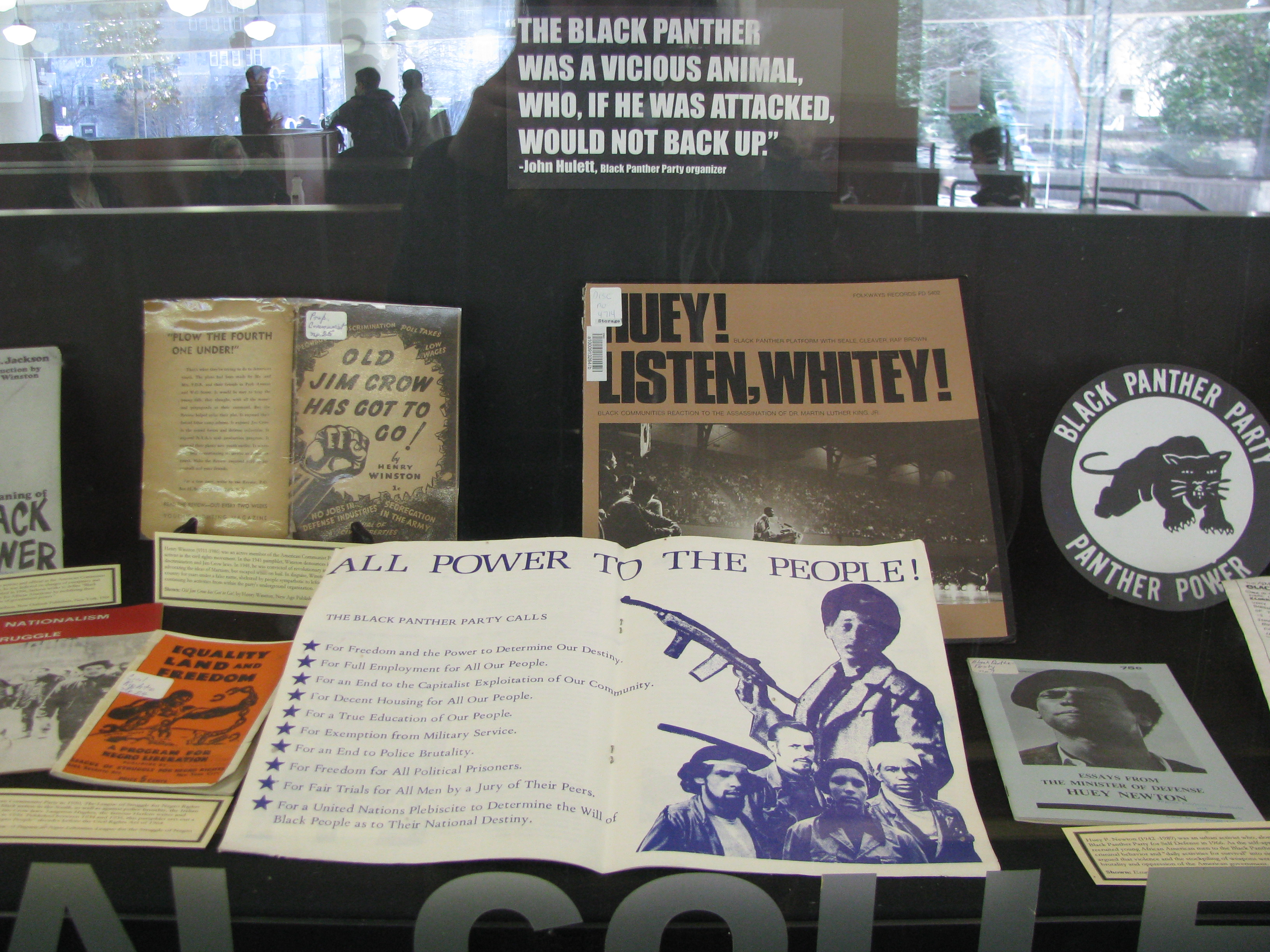
Power to the People! The Revolutionary Literature of the Black Panthers


In celebration of Black History Month, the Special Collections reading room is currently displaying an exhibit on the Black Panther Party and the Black Power movement. The exhibit includes Black Panther newspapers and pamphlets published in the 1960s and 1970s, as well as earlier civil rights literature from the American Communist Party.

The Black Panther Party (originally the Black Panther Party for Self-Defense) was an African-American revolutionary socialist organization active in the United States from 1966 until 1982. It was founded in Oakland, California by Huey Newton and Bobby Seale. The partys inflammatory speech and advocation of violence for political gain made it extremely controversial, even within the Black Power movement. The Panthers were famous for organizing armed citizens patrols to evaluate behavior of police officers. Chants such as The Revolution has come, it’s time to pick up the gun. Off the pigs! pitted them against the establishment and increased racial tensions. The Panthers took advantage of a California law that permitted carrying a loaded rifle or shotgun as long as it was publicly displayed and pointed at no one. In their most famous incident, in May, 1967, 30 members entered the California State Assembly carrying their armed weapons- an event which was widely publicized, and which prompted a major overhaul in gun legislation. Despite the social program work performed by the Panthers, including the creation of a community school and free food programs, the criminal activities of Black Panther members and their confrontational, militant, and violent tactics against police caused the party to lose support in the civil rights community. To this day, the Black Panthers are infamous figures, representing a violent turn in the Black Power movement.

Special Collections owns six original issues of the Black Panther Partys official newspaper, The Black Panther, which are featured in this exhibit. The issues contain stories of injustice and police brutality, cartoons and information on how to carry out guerrilla attacks against the people and institutions the Black Panthers considered oppressive. Additionally, the front and back covers are adorned with the iconic art illustrations made by artist and Black Panther Minister of Culture Emory Douglas.

The pamphlets in the exhibit feature essays by important Black Panther leaders, including co-founder and self-appointed Minister of Defense Huey P. Newton. There is also a comic book titled The Adventures of Black Eldridge recounting the mythical exploits of Eldridge Cleaver. As Minister of Information, Cleaver was editor of the The Black Panther newspaper and exerted a lot of influence on the message and direction of the party.

Also included are pamphlets of earlier Black Power literature, all of which was affiliated with the American Communist Party. From the 1930s through the 1950s, the American Communists were at the forefront of promoting equal rights for African Americans and were intimately connected with the Black Power movement. One such pamphlet, entitled Equality, Land and Freedom: A Program for Negro Liberation, was published by The League of Struggle for Negro Rights, a group organized by the American Communist Party in 1930. The League campaigned for a separate black nation in the South, as well as against police brutality and Jim Crow laws. Langston Hughes, the famous Harlem writer and activist, became its President in 1934. Published between 1934 and 1935, this pamphlet sets out a Bill of Civil Rights for the Negro People decades before the Civil Rights Act of 1964.

Another pamphlet, The Road to Liberation for the Negro People, was published in 1937 by the Daily Worker, a Communist newspaper. The Meaning of Black Powerwas written by James E. Jackson Jr., an official in the American Communist Party. During the McCarthy era in the early 1950s, he was indicted on charges of conspiracy and spent five years in hiding. In this pamphlet, published in 1966, Jackson works to define Black Power as a movement to bring about equal rights for African Americans by mobilizing these populations to vote and secure their rightful share of government power.

These are artifacts from a volatile period of American history as we struggled to achieve equality, documents that demonstrate the intensity and passion of those working for African American freedom and recognition.The exhibit will be up through the end of the month, so come take a look!

Love, Life & Work: Advice and Art for the Ages

Title Pages from Love, Life & Work by Elbert Hubbard (East Aurora, NY: The Roycrofters, 1906.)

At the turn of the 20th century, America was in the throes of a remarkable transformation. The great agrarian society was quickly becoming a mechanically driven economy. Some, however, spoke out against the advances of industrialization, arguing that mass production subjugated workers to machines and that no machine could match the quality of craftsmanship that came from an artists hand. It was this reaction that gave rise to the Arts and Crafts Movement.

Elbert Green Hubbard (June 19, 1856 May 7, 1915) was an American writer, publisher, artist, and philosopher. Raised in Illinois, he met early success as a traveling salesman with a soap company but dropped out of this lucrative career to become a writer and soon discovered the idealized world of Arts and Crafts. Hubbard is most famous for founding the Roycroft artisan community in East Aurora, New York, an influential exponent of Arts and Crafts in the United States.

During his lifetime, Hubbard became well known throughout the nation as a writer, a philosopher and a lecturer. His eccentric and flamboyant style and seemingly non-conformist ideology endeared him to many readers. He was both a reflection of and a reaction to his times, taking center stage in American thought and becoming an icon of popular culture. Hubbard described himself as an anarchist and a socialist. He believed in social, economic, domestic, political, mental and spiritual freedom and his philosophies are clearly evident in his publication: Love, Life & Work; Being a Book of Opinions Reasonably Good-Natvred Concerning How to Attain the Highest Happiness for Ones Self with the Least Possible Harm to Others, a copy of which is held in Special Collections.

Although the text of this novella is readily available in ebook format, there is something special about examining the physical work. Virginia Tech is home to a first edition, published in 1906, bound in soft leather with the title embossed on the cover and representative of the simplified illustration style and handcrafted appearance that characterized the era.

Bookmaking played an important role in the Arts and Crafts Movement. Like other decorative arts, there was a rising concern over the detrimental effects of mass production on book design. Hubbard and his fellow Roycrofters sought to rectify this through their own private press, which emphasized high quality hand production: handmade papers, heavy inking, original typefaces, and designs that looked back to medieval illuminated manuscripts and incunabula and often included elaborate wood engravings.

The text itself is a compilation of thirty short essays on a variety of topics ranging from Mental Attitude to Love and Faith and although Hubbard makes many references to contemporary issues and personalities, a vast majority of his advice is still relevant in modern times. The following are just a few of the bits of wisdom and insight that Hubbard shares with readers:

Character is the result of two things, mental attitude, and the way we spend our time. It is what we think and what we do that make us what we are.

The world bestows its big prizes, both in money and honors, for but one thing. And that is Initiative. What is Initiative? Ill tell you: It is doing the right thing without being told.

To do your work well to-day, is the certain preparation for something better to-morrow. The past has gone from us forever; the future we cannot reach; the present alone is ours. Each day’s work is a preparation for the next day’s duties. Live in the present–the Day is here, the time is Now.

Members of the Virginia Tech community are invited to come visit us at Special Collections to examine Love, Life & Work, other influential texts by Elbert Hubbard, and additional examples of Arts and Crafts style printing and illustration.

Love in Wartime

I dont know how much pleasure it affords you to go over these days of the past, but to me they will ever be remembered as days of felicity. And how happy the thought that years increase the affection & esteem we have for each other to love & be loved. May it ever be so, and may I ever be a husband worthy of your warmest affections. May I make you happy and in so doing be made happy in return. A sweet kiss and embrace to your greeting.

But maybe you will say it looks ridiculous to see a man getting grayhaired to be writing love letters, so I will use the remnant of my paper otherwise…
Yours affectionately H Black

Harvey Black (1827-1888) was a physician in Southwest Virginia. When the Civil War broke out, he was attached to the4th Virginia, 1st Brigade, known as the Stonewall Brigade. In 1863, he wrote a love letter to his wife Mary (who he affectionately called “Mollie”)in Blacksburg, recalling their courtship. The quote above comes from the last few lines. You can see a transcript of the letter online, and you can read more about the Black family and their papers at Special Collections here.

Happy (early) Valentine’s Day!

Looking Back at the Library

Virginia Tech has a long history and the library (or rather, a library) has always been a part of it. When the university opened in 1872, there was only a single building and the library was in a room that served as both a library and an office, with an attached reading room. By 1882, the library had moved to the second floor of the Second Academic Building.

Old Library, 1905
Old Library, 1905

By the mid-1910s, what is sometimes referred to as “the Old Library,” had taken up residence in the former chapel. The chapel was the second structure on the site of the current Newman Library (the first was a lecture and laboratory building).

Old Library, interior, 1930
Old Library, exterior, March 1953
Old Library, during the fire, August 1953

In August of 1953, the library burned in a fire. Construction of the Carol M. Newman Library began shortly after, and was completed in 1955. The images below show the finished marble staircase on the second floor, and the building from outside. (The pedestrian plaza between the library, the bookstore, Squires Student Center, and the current Graduate Life Center came later.)

Newman Library, entrance interior, c.1953
Newman Library, exterior (looking toward the current plaza between the library and bookstore), 1978

The interior of the library, at least in the older part of the building, may not look all that different. Stacks have moved and reference desks have shifted, but those familiar pillars and windows are present today. The addition, which includes the glass wall on the first floor, was completed in 1981 (after the pictures below).

Newman Library, interior, 1963
Newman Library, interior, 1971

Today’s building has come a long way from a single shared room in the only building on campus, but the goals are still the same: connecting students, staff, faculty, and the larger research community to the resources they need.

The pictures in this post came from the Special Collections’ Historical Photograph Collection. We have thousands of photographs documenting the history of Virginia Tech, from the Corps of Cadets to sports, and from buildings to faculty and staff. There are also lots of photos of Blacksburg and its many changes through the years. So if you’re curious what the corner of Main St. and College Ave. looked like the 1930s, who the first squadron of women were in the Corps of Cadets, or when basketball shorts really were short, we might just be able to help.

Opinion Makers: Women writers on architecture

The world of architecture lost a passionate and opinionated voice when Ada Louise Huxtable, architecture critic for The New York Times (1963-1982) and The Wall Street Journal (1997-), died earlier this month at the age of 91. How opinionated was she? Check out this New Yorker cartoon by Alan Dunn that appeared in 1968. And although the Pulitzer Prize-winner was the first full-time architecture critic at an American newspaper when she started at The New York Times in 1963, she was actually following a tradition of women who wrote about extant architecture.

Book Cover, 'The House in Good Taste' by Elsie de Wolfe
Americas first decorator. Elsie de Wolfe’s seminal book that banished Victorian gloom. Special Collections call number: SPEC Large NK2115 D6 c.2

In the mid-to-late 19th century architecture was a relatively new profession engaged in a public campaign to separate itself from common builders. Authors such as Louisa C. Tuthill, Mariana Van Rensselaer, Mary H. Northend, Edith Wharton, and Elsie de Wolfe served as intermediaries between the lay audience (i.e. potential client base) and architects. Though not trained in architecture per se, these women were often from privileged backgrounds that afforded them the highest levels of private education, an early knowledge of art and culture, and the ability to travel often abroad. They published primarily in general periodicals aimed at the emerging middle class: Century, House and Garden, and American Homes and Gardens, although some such as Van Rensselaer did contribute to the trade publication American Architect and Building News (AABN).

Embracing the 19th-century notion of the cult of domesticity, they served as style dictators endorsing particular aesthetics and architects, and instructing the new glut of middle class homeowners on how to create a domestic sanctuary. Subjects such as the history of architecture and general principles of architecture were also perennial topics during this period.

Book page, 'The History of Architecture' by Louisa C. Tuthill
Page from Louisa C. Tuthill’s “The History of Architecture from the Earliest Times: Its Present Conditions in Europe and the Unites States (1848). Special Collections call number: SPEC LARGE NA200 T8 1848

Their writings did not go unnoticed by the professional architecture establishment. Van Rensselaer was praised by the profession and even had her essay Client and Architecture recommended for reprint and distribution at an American Institute of Architects (AIA) meeting (1890). She was made an honorary member of the AIA that same year. The tables could quickly turn, however, as they did in 1892 when the AABN panned Van Rensselaers book English Cathedrals saying that it smacks of the magazine and so, almost of the literary hack.

The entry of women into an architecture practice that did not center around the domestic sphere would be a gradual one that would eventually make way for renowned critics such as Huxtable and Pritzker-winning starchitects.

Want to know more about women in architecture? Special Collections is home to the International Archive of Women in Architecture. Visit the IAWA page or come see us in person!

**The historical research for this post was culled from Lisa Koenigsberg’s book “Professionalizing domesticity: a tradition of American women writers on architecture, 1848-1913.” and her essay ‘Mariana Van Rensselaer: An architecture critic in context’ published in “Architecture a place for women.” **