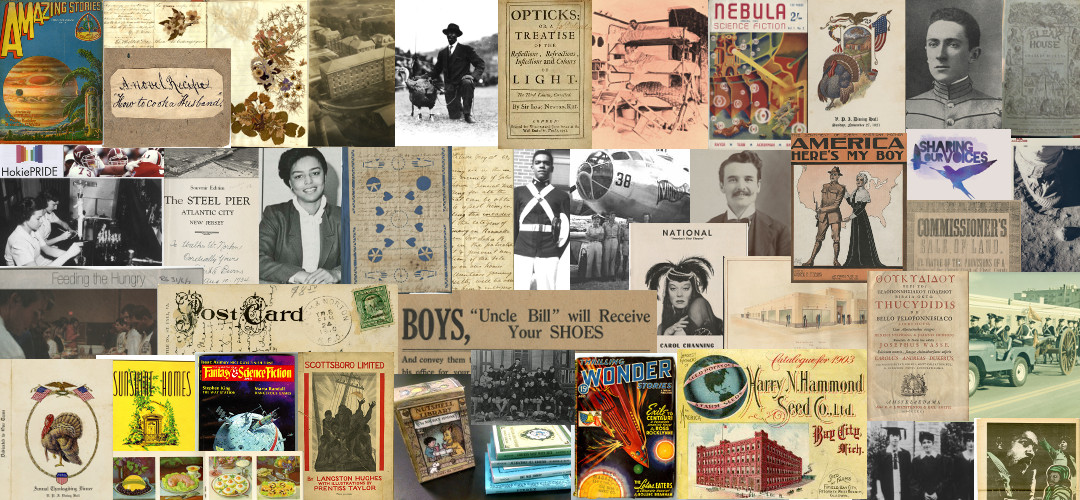
Want an opportunity to win $2500 and take a road trip to Virginia Tech Special Collections? (Airlines, cruise ships, or a brief walk across the Drillfield are other forms of acceptable transportation.)
Milka Bliznakov, IAWA founder
Well, you are in luck because proposals are now being accepted for the annualMilka Bliznakov Research Prize sponsored by the International Archive of Women in Architecture Center, Virginia Tech.
The Board of Advisors of the International Archive of Women in Architecture Center (IAWA) presents this Annual Prize of $2500 (with an additional $500 available for travel) in honor of IAWA founder Milka Bliznakov.
The Prize is open to architects, scholars, professionals, students, and independent researchers with research projects that would benefit from access to the IAWAs collections.
More details and submission guidelines can be found here. The proposal must be submitted by May 1st, 2014. The winner will be announced by June 15th, 2014.
Spring has officially begun, and it’s time to start planning out gardens and planting seeds. Seed catalogs, with their plethora of new and unusual varieties to grow and try, have been a typical part of Spring gardening preparations for a very long time. With that in mind, I decided to take a look at what past years have had to offer in Special Collections’ old seed catalogs.
The one that caught my eye was less a seed catalog and more a tour de force of vegetables and flowers in lithographic design. The Manual of Everything for the Garden, an annual seed catalog published by Peter Henderson & Company of New York, contains some of the most beautiful vegetable illustrations I have ever seen. Through their illustrated catalog, one could order nearly everything for the garden and yard, including seeds for vegetables, fruits, grasses, grains, and flowers, as well as gardening tools and equipment. Henderson founded the company in 1871, and by his death in 1890 it was one of the most successful seed companies in the United States. His son, Alfred Henderson, took over the business after his father’s death and continued the success- from the 1890s though the 1920s the company mailed out some 750,000 copies of its annual seed catalog each year. Yet despite its popularity, finding an intact Peter Henderson & Co. catalog today is extremely rare. The exceptional quality of their color plates and chromolithography made them highly sought after for the popular Victorian pastimes of scrapbooking and decoupage, resulting in most being cut to pieces.
Virginia Tech Special Collections is lucky enough to have a first edition copy of the 1898 catalog, which has survived completely intact, including two tipped in price lists. Nearly all of its 190 pages are filled with highly detailed chromolithographic prints, illustrating all the botanical splendor that the company’s seeds promise to grow. These beautiful graphics were made by Gray Lithograph Co. of New York, and Stecken Lithographic Co. of Rochester, NY, one of the largest centers of lithography in the country. As the long and dreary winter dragged on, I can only imagine how exciting flipping through these pages in anticipation of Spring would have been.
If you’re in or around Blacksburg, there are two upcoming events you may want to know about! On March 24, 2014, the University Libraries is co-hosting the Third Annual Edible Book Contest with the Blacksburg branch of the Montgomery-Floyd Public Libraries. There’s still plenty of time to register for the event (and we won’t turn you away at the door, either). You can visit the website to find out more and sign up:http://tinyurl.com/AEBC2014. Even if you don’t want to enter, please come to the Blacksburg Public Library from 6-7pm on March 24th. It’s your votes that will help us determine the winners in each category!
And, on March 25th from 5-7pm, the University Libraries will be hosting the Second Annual Appalanche. Appalanche is a celebration of Appalachian culture. This year, the event will include music and food, as well as displays and information about wildflowers, quilting, apples, the Wilderness Road Museum, and more! Be sure to stop by and visit us on the first floor of Newman Library that evening!
It’s research paper time at Virginia Tech! And when it comes to research papers relating to local (and many other) topics, a visit to Special Collections is indispensable. Let’s examine the different ways that Special Collections can help you with a research paper, using Blacksburg’s Lyric Theater–a perennial favorite among students–as an example. (If you don’t need advice on research methods, you can just look at the pretty pictures below!)
The So-Called Independent Approach. You know that you don’t need Special Collections because everything you need for any research paper can be found online. A simple Google search on “lyric theater blacksburg history” takes you to the Lyric’s website, and you find some very useful information there. Soon, though, you realize that, even with some judicious padding, big fonts, and wide margins, you’re not going to have enough for a paper. You go back to Google and run across “The Lyric Theatre: A Look Back at the Beginnings.” The page is a little dated, but it links to a lot of helpful information and images. Now you’ve got a lot more for your paper. Surprise! You’ve just been helped by Special Collections! The problem with this approach is that the Lyric is one of only a few such pages that we’ve put together, and helpful as this page might be, it’s probably not enough for your needs.
The Not-Quite-Novice Approach. You know from experience that the library is a vital starting point for any research project but have never been to Special Collections. You go to the library’s catalog and do a keyword search on blacksburg lyric theater, which pulls just one hit, for The Lyric Resource Notebook, compiled by Stephen Michener in 1994. You visit Special Collections, find a few things in the Resource Notebook to add to your paper, and leave, mistakenly thinking that you’ve found all that the department has on the topic.
The Experienced Approach. You know that Special Collections holds more than books and that you can find these materials through links on the Special Collections website. Through a link on the homepage, you search “lyric” on the Virginia Heritage database and learn that Special Collections also holds a Lyric-related folder in the Vertical Files. You ask for this and are given a folder thick with newsclippings and other materials relating to all areas of the Lyrics history, from its construction, to its renovation, to the recent conversion to digital projection. Another link takes you to the Imagebase, and a search there finds more than a dozen Lyric-related photographs. Digging deeply into the department’s Manuscript Collections Guide, you find that we hold the papers of Smithey & Boynton, the architectural firm that designed the theater building, and that the collection includes the firm’s sketches, building plans, and architectural detail drawings for the Lyric.
The Savvy Approach. You know that Special Collections holds some things that simply aren’t on the public radar and that the archivists are on hand to help you find these things. Using the Savvy Approach, you ask for help. With a simple “What else do you have on the Lyric?” you learn that Special Collections has a substantial collection of monthly calendar-programs that were mailed to local residents from the 1930s through the 1970s.
In addition to showing what was playing on specific dates, the calendars also provide other details on the theater’s operation.
You’re also shown a large collection of lobby cards distributed to the theater’s patrons. The cards all seem to date from the silent film era and are presented in a wide array of shapes and sizes, revealing something not only of the era’s films but also of its marketing techniques.
Because they’ve not yet been processed, these two collections aren’t often used, and they can give your paper an interesting and unusual angle, one that you’d not had if you hadn’t asked a simple question.
So there you have four approaches to a local history research paper, and Special Collections provided some help to each. If you think that it seemed like too much effort to find everything the department has on a single topic, we agree. Although our materials are much more easily accessible to researchers than they were, say, 20 years ago, we’re constantly striving to make things easier, so that searching in several different places or relying on an archivist’s memory to find everything won’t be necessary. Until that distant day when everything is retrievable through a single search, though, remember to use the Savvy Approach and ask us for help. That’s what we’re here for.
March is Women’s History Month. Over on the History of Food & Drink blog, I’ll be profiling women who made contributions and influenced American culinary history. Which got me thinking about our other manuscript collections, women who lived through American history and women whose words are on our shelves. If you had the time to look through our nearly 1800 collections, you would find many women’s names. Most of them aren’t famous, but their letters, diaries, architectural drawings, cookbooks, and other papers can be important both as individual objects and in the larger context.
That being said, I thought I’d share Nancy B. Harbin’s letter. Written in the second year of the American Civil War, Nancy writes from Calhoun County, Mississippi to her sons in Richmond, Virginia. Jack, John, and Edward all served with Company F, 42nd Regiment, Mississippi Infantry.
Page 1
Page 2
Page 3
Page 4
Transcript, part I
Transcript, part II
As with many mothers, her concern is first and foremost for the well-being of her sons. Her letter is really two letters: one to Jack and a second to John. She doesn’t write Edward directly, which may be the result of his being “so near death.” It is unclear if he was sick or injured. (Our research on the family wasn’t as fruitful as we might hope–which sometimes the case–and we don’t know if any of Nancy’s sons survived the war. ) On the one hand, this is a letter from a mother to her children, providing them updates from home, sharing her concern and love for them, and encouraging them. On the other, the very fact that it has survived 152 years makes it an important part of the larger body of Civil War materials in our collections and far more than a simple letter from mother to sons. BecauseNancy’s concerns are what we might expect from such a letter, it is both specific to her family anda representative voice of the Civil War home front correspondence of the time.
We have other home front letters from women (and men!) in our Civil War holdings, and if you were to keep reading, you would see similar themes, regardless of location, relationship, or loyalty. If you’d like to do so, come visit us and we’ll be happy to help!
Bookplate found on the inside front cover of many books from Kohler’s collection.
Drawing of Dayton Kohler by Karl Jacob Belser, 1931.
If you have an interest in modernist literature and have, on occasion, requested Special Collections’ copies of such worksespecially by American writers of fiction, though not exclusivelyyou may have discovered the bookplate shown above with a startling frequency. “From the Collection of Dayton Kohler . . . Virginia Polytechnic Institute . . . Carol M. Newman Library” appears time after time in books by many of the great writers of our time in the Rare Book collection. When I first started working here, just about five and a half years ago, as I came upon first editions of Faulkner, Hemingway, Cather, and Fitzgerald; then Virginia Woolf, D. H. Lawrence, and Joseph Conrad; Saul Bellow, Katherine Anne Porter, Eudora Welty, James Thurber, J.D. Salinger, Reynolds Price, William Styron, and more, I kept noticing the same bookplate. All first editions, several of them signed by the author. Who was Dayton Kohler?
Select first editions from the collection of Dayton Kohler
Kohler was Professor of English at Virginia Tech. He retired in 1970 after arriving at this institution as an Instructor in 1929. Born in 1906 and a graduate of Gettysburg College, he received his master’s degree from the University of Virginia the same year he came to Blacksburg. In 1931, Karl Belser, a colleague in the Department of Architectural Engineering drew a sketch of Kohler (shown above) that is housed, along with several other prints and drawings, in the Karl Jacob Belser Illustrations, 1931-1932, 1938, n.d., also at Special Collections. Kohler’s own collection of papers is also on hand. It includes an extensive correspondence with authors and other critics of the time, much of which relates to various literary essays and reviews.
Dayton Kohler died in 1972, but not before arranging for a collection of his booksincluding many 20th-century first editionsto become part of Special Collections. In fact, former director of Special Collections Glenn McMullen said in a June 1990 Roanoke Times and World News article that acquisition of Kohler’s book collection was “the first major acquisition” for the new department that had only formed in 1970. A May 21, 1971 memo to then-library director Gerald Rudolph reports that 1095 books were received from Professor Kohler some ten days earlier. The list that accompanies the memo shows only authors and quantity, with no detail regarding title and/or edition. But, in addition to the names referenced above, the list includes William Carlos Williams, John Dos Passos, Truman Capote, Henry James, Ezra Pound, James Joyce (a trip to the shelves indicates the 1930 edition of Ulysses, not the 1922 first edition, was Kohler’s), and a total of 27 Hemingways and 38 Faulkners(!), plus much, much more. What a tremendous legacy for the Library and its patrons to use and enjoy. I’m sure there are still more terrific editions in the collection that I haven’t yet seen. To close (almost) this post, I’ll leave you with one more that I did find:
Jacket of Fitzgerald’s The Great Gatsby, 1925.
Inside front cover of The Great Gatsby (1925) with F. Scott Fitzgerald’s inscription to Dayton Kohler, dated 1934.
Lastly, if any alumni who may remember Professor Kohler read this post and wish to tell us more about him, please consider leaving a comment below. We’d be pleased to add them to this post. Thanks!
With the help of our new digital library site, VT Special Collections Online, we will soon be sharing some of our digitized civil war diaries in new and interesting ways. Using plugins designed by Neatline will allow us to create exhibits that display both transcripts and digital images of diary entries on timelines or as location points on maps. An early example of this can be seen with The Richard Colburn Diary.
Colburn, of Ellington, Iowa, started his diary on December 18, 1861, the day he enlisted in the 12th Infantry of the United States Regular Army. After two months of training he traveled east to New York and Washington DC, entering the fight to defend the Union. His daily diary entries recount his movements, which when plotted on the map, illustrates the vast distance he traveled to fight, as well as the significant difference that railroads made to travel.
Colburn’s 12th Infantry became involved in the Peninsula Campaign, including the Battle of Williamsburg and the Battle of Gaines’ Mill, where on June 27, 1862, Coburn was wounded and taken prisoner by the 5th regiment of Virginia. The remainder of the diary describes his hospitalization, his release on January 15, 1863, and his trip home. The exhibit helps to visualize his experience in the Civil War in an age of GIS and global connectivity. By overlaying his journey onto modern maps, it is easier to connect our world today with the events that took place over 150 years ago.
In a video interview on March 12, 2013, Beatrice Freeman Walker talked about growing up in Blacksburg during segregation, the changes she has observed in the town, and the historical significance of the St. Luke and Odd Fellows Hall. Mrs. Walker, who died on December 31, 2013, was a dynamic community member and cared deeply about the preservation of Blacksburgs African American history.
Born in 1926, the youngest of five siblings, Mrs. Walker grew up in Blacksburg at 202 Jackson Street. Her familys property went all the way to Progress Street where her father, Alonzo Freeman, had his dry cleaning business. Their home was on the border of the towns original grid of 16 blocks, which was laid out by William Black in 1797 and bounded by Draper Road, Jackson Street, Wharton Street, and Clay Street. In the 1970s, the town acquired her family home though eminent domain in order to expand the fire department, and she lived the remainder of her life in Christiansburg.
In the interview she recalled that when she was growing up, the children were unconscious of segregation. There were blacks on one side of the street and whites lived on the other. The problem, she said, It isnt the children. Its the parents.
At various times, her family also owned a beauty salon, an ice cream parlor where they served homemade hand-cranked ice cream, and a recreation place called Paradise View on what was then Grissom Lane, but is now called Nellys Cave. Daddy just owned it because we had croquet, horseshoe, badminton, bands, and sandwiches and sodas, she said. They would go up there for recreation. It was open on Saturdays and Sundays. People as far as Bluefield, West Virginia would come in and down there.
Among other jobs, Bessie (Briggs) Freeman, Mrs. Walkers mother, traveled in order to encourage membership in the St. Luke and Odd Fellows. This organization was important to the African American community because it helped people find opportunities for learning different trades and it sold insurance that people could borrow from when they wanted to send a child to college or when there was a death. The St. Luke and Odd Fellows Hall, built in the early 1900s, provided a gathering place for meetings, social events, and fundraisers.
Junior class, Christiansburg Institute, 1942. Beatrice Freeman, a class officer, is second row, second from the right.
After graduating from Christiansburg Institute in 1943, Mrs. Walker did civil service work in Washington, D.C. Later, she returned to Blacksburg and worked for several local businesses including Spudnuts (later called Carol Lee Doughnut Shop) on College Avenue, Litton Poly-Scientific, and in 1975, Volvo White Motor Company in Dublin, Virginia. While at Volvo, she was active in the United Auto Workers (Local 2069) and a strong advocate for her fellow employees.
St. Luke and Odd Fellows Hall
Beatrice Freeman Walker was instrumental in the renovation of the Order of St. Lukes and Odd Fellows Museum Hall in Blacksburg. In 2004, Mrs. Walker, Walter Lewis, and Aubrey Mills were appointed as trustees.
Beatrice Freeman Walkers video oral history interview, which was conducted at the St.Luke and Odd Fellows Hall, may be accessed from Virginia Techs institutional repository, VTechWorks, managed by the University Libraries at http://vtechworks.lib.vt.edu/handle/10919/24714 Mrs. Walkers granddaughter, Latanya Walker, was present at the interview conducted by Tamara Kennelly. Scott Pennington was the videographer.
Today I finished up the first phases of work on a great collection of Civil War correspondence. The collection includes 19 letters by 18 different authors. Unless there’s a connection (usually family, business/organization, institutional, or something along those lines), we tend to name and organize collections based on the creators. So, under “normal” conditions, if such a thing exists (one of our favorite phrases in the archives world is “it depends”), these letters might have ended up as 17 collections (two of the letter writers are brothers). These 19 letters, though, have something else in common: location. Each was written in or around Alexandria and Fairfax counties in Virginia. And each was written within the first 16 months of the Civil War. As a result of that, we’ve decided to treat them as a single, cohesive unit. This group of letters offers a unique perspective on the early experiences of Union and Confederate soldiers around Washington DC in the early months of the war. There are number of common elements: regiments cutting down trees to build up defenses, skirmishes between forces, the need for food and clothes from home, and a frequent hope that soldiers “hope to be home soon.”
You can see the finding aid for the Alexandria and Fairfax Counties [Virginia] Civil War Correspondence (Ms2013-029) online here. The contents list of the finding aid includes links to the digitized letters and, when available, the transcripts. You can also go straight to Omeka (our emerging digital content platform) and see the letters and transcripts here. The digital images all have links back to the finding aid, as well. The idea is that we’re creating online connections to help our researchers move back and forth from digitized primary sources to context for those materials easily.
Franklin B. Lukens served in Company E of the 3rd Regiment, New Jersey Infantry. His December 9, 1861 letter to his parents mentions that there is a man missing who has not been found. He talks about a woman who is a Secessionist and her slaves. He closes by asking them to write soon.
This collection remains a work-in-progress, as we expect new materials from the donor in 2014 and into the future. As new materials arrive, we’ll continue digitize them and update the finding aid. We’ll be able to offer new insight into early war-time conditions and experiences as the collection continues to grow.
The Alexandria and Fairfax Counties [Virginia] Civil War Correspondence (Ms2013-029) is not the first collection we’ve placed in Omeka (https://omeka.lib.vt.edu/), nor is it the first one we’ve digitized, but it’s the first one to go through acquisition, digitization, processing, and addition to the web in sequence and within a short period of time. We hope it will help us create and shape our workflow for the future as we digitize more collections. It may not be a speedy process, so we also hope you’ll bear with us as we create new material to share. We promise, it’ll be worth it.
In recent posts I have tended to dwell on science fiction magazine cover art. In my own case, at least, the exterior artwork is still doing its job: attracting attention to the contents within. Hopefully they are as exciting as the cover, right? But artwork is only a single point of entry into the study of science fiction pulps as artifacts.
And I can only assume we are keeping them in the first place in order to preserve the artifactual value. [there is a pretty significant Greenwood microfilm series of the early SF magazines] I’m not sure if the mainstream of analytical bibliography or its book history morph has yet to reach yellow-backs or dime novels, much less the pulps or their post-war paperback successors. The established bibliographical methods are generally appropriate only to hand-made books, so much more variable (and personal and evocative) than the relatively anonymous products of the popular machine press. And there is very little mystery in an actual copy of Amazing Stories. But there are some notable varieties of textual and extra-textual content which accompany and broadly inform the fantastic features which were the ostensible point of the science fiction pulps and related publications, and which are attention-worthy. How about:
Advertising
“Pulpwood magazines offer two methods of escape from reality: one, by their fiction – that magic carpet that carries the reader off to parts unknown; the other, by their advertising of comparatively inexpensive means to keep the reader physically and mentally fit so that he can take the hero’s part in any romantic adventures he reads about, or dreams of having himself . . . . Advertising pages are as much a part of the magazine as those devoted to stories: parallel lines spoken by two sets of people but with a single thought: to catch and hold the reader’s attention.”
Harold Brainerd Hersey, “Pulpwood Editor: The Fabulous World of the Thriller Magazines Revealed by a Veteran Editor and Publisher (Greenwood, 1974): 77, 83.
The ads are fun, but the question is: to what degree they were tailored to SF pulp readers specifically? Could you infer that this demographic was underemployed, musically-challenged, and spindly to a degree that the western pulp readership was not? Were their noses more unsatisfactory than the norm?
The tough part about having deep holdings in SF magazines but not in other category pulps is that such comparisons are difficult, so I have to lean on Algis Budrys for some commentary (as far as I know, the only commentary of its kind germane to advertising policy in SFnal publications). In the following quote, he is trying to prove a larger point (grind a bigger ax) about the essential triviality of magazine SF, or at least to point out some of the the more unexpected influences on the literature which may not be appreciated by most scholars or other publishing neophytes, and he accidentally provides us with an interesting bit about the ads:
“From the publishers’ point of view, the competition for readers during the chain period was a competition not between authors (who were regarded as ‘bylines,’ that is, as blurb material in most respects), and not even between individual magazine titles and genres within the chains, but between chains . . . . The publishers’ view of things can be deduced from the fact that advertising in the magazines was sold not by the individual title but by the chain; the only smaller unit offered was the ‘group’ within the chain. The content of the advertising – for High John the (luck-bringing) Conqueror Root, for an ‘encyclopedia’ of Female Beauty Around the World with supplementary torture photographs from the Orient, and for the Audel home-workshop manuals – conveys a very specific picture of the perceived demographics of the chain audience.”
Budrys, “Non-Literary Influences on Science Fiction,” (Borgo Press, 1983): 7.
So, the ads are not necessarily an absolutely essential source of information on readership, at least not SF genre-specific readerships. But they interesting nonetheless, and definitely entertaining. You might even call them evocative (Budrys would say: evocative of exploitation and disdain).