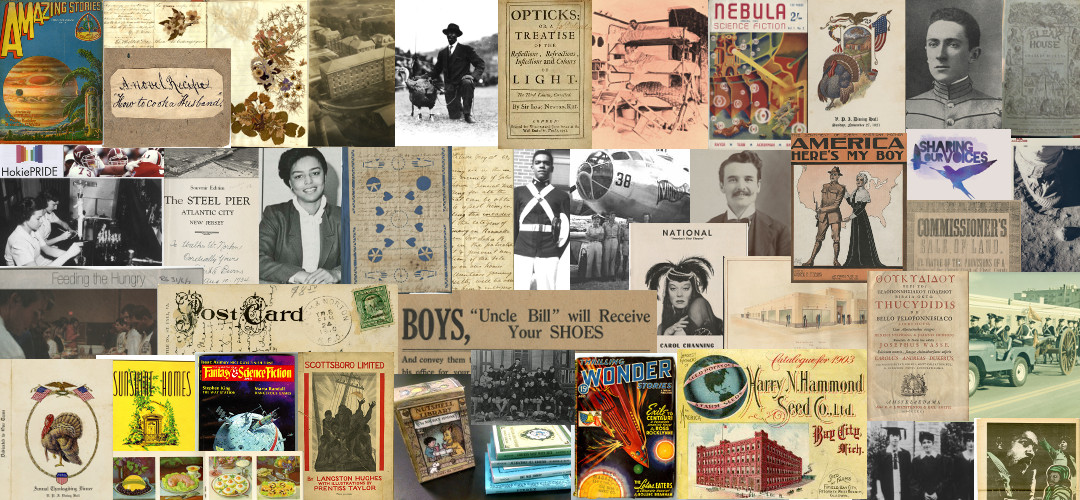
Pop Culture Artifacts from the Heron Collection of Speculative Fiction

Over the course of a few years in the late 1980s and early 1990s, Virginia Tech Special Collections acquired the William J. Heron Collection of Speculative Fiction. The Heron collection includes approximately 5,000 issues of American, British, and Australian science fiction magazines. These magazines are notable not just for their content, but also have enduring appeal as cultural objects. Many early science fiction stories, especially magazine material from the 1940s and 1950s, have been variously reprinted, anthologized, expanded into book length, or otherwise modified for commercial re-use. So, seeing the original published setting of a story, or knowing that a given setting is not the first, provides a context for understanding its readership. And the cover art, which was usually original work, is always different and interesting in one way or another. As this is likely the first in an ongoing series of installments on science fiction magazines and their art and artists, the following images are all “firsts” from the great magazines, and all are from our collection. Of the four magazines represented here, both Astounding (which was retitled Analog in 1960) and Magazine of Fantasy (now know as Magazine of Fantasy & Science Fiction) are still in publication. Astounding/Analog has been in continuous publication for almost 100 years!

Amazing Stories April 1926

Amazing #1, April 1926, Experimenter Publishing (cover by Frank Paul)

Astounding Stories

Astounding #1, January 1930, Clayton Magazines (cover by H.W. Wessolowski, aka Wesso)

Magazine of Fantasy

Magazine of Fantasy #1, Fall 1949, Mystery House (cover by Bill Stone)

Galaxy Science Fiction

Galaxy #1, October 1950, World Editions (cover by David Stone)

Have You Ever Seen A Pancake Fly? How Does It Do It?

Among the materials in the Robert R. Gilruth Papers (Ms1990-053) is his 1936 Master’s thesis from the University of Minnesota, “The Effect of Wing-Tip Propellers on the Aerodynamic Characteristics of a Low Aspect Ratio Wing.” Gilruth, who would move on to work, first, as a flight research engineer at Langley Aeronautical Laboratory of the National Advisory Committee for Aeronautics (NACA), and then for NASA, became the first director of that agency’s Manned Spacecraft Center in Houston in 1961. The Master’s paper, however, was what interested the folks at the Vought Aircraft Historical Foundation, who contacted Special Collections as they were preparing a history of the company’s V-173 and XF5U-1 “Pancake” series of aircraft.

A look at the model used in this early work of Gilruth’s and the prototypes built by Vought in the 1940s suggests the significance of his work for the company’s engineers at the time. So, how does a pancake fly? For those of you who want to know, check out Gilruth’s Thesis for all the theory, specs, charts, and diagrams.

Aviation and Aerospace define an important collecting area for Special Collections. The Gilruth Papers, for example, contain research articles, speeches, photographs, agency and professional papers, and more that span a fifty year career in aerospace.

For more information, read about our Archives of American Aerospace Exploration or visit us at Special Collections!

Battlefield Diary 1862: Lieutenant William W. Barnett . . . or is it? “Who?” is only the beginning!

Barnett Diary Spine and PagesThe diary arrived in a handsome case that clearly identifies the contents as the work of Lieutenant William W. Barnett. A legible note in the front of the diary tells us that Barnett served in the 8th Pennsylvania Reserves. Records indicate, however, that Barnett mustered in with the 8th as a private in Company A on 15 May 1861 and was discharged on a Surgeon’s Certificate on 20 March 1863, also as a private! Who is our lieutenant?

The records do show a William H. Barnett of the 8th PRVC, Company A, whose name was sometime recorded as William W. Barnett. There is another William W. Barnett, also serving in the same regiment and company, but with a different enlistment record than man discharged in March 1863, a record that is also contradicted by events recorded in the diary. A history of the 8th reports that this regiment consisted of men from Armstrong Co. in western Pennsylvania. The 1860 census for that county lists at least three William or W. H. Barnetts ranging in age from 19 to 21. Who is William Barnett?

Once you know what you might be looking for, the clues in the diary itself are easier to spot. On 15 September, Barnett writes, “This day is my birthday and I am twenty one years old and in the hospital.” This suggests our Barnett would be 19 in June 1860, the time of the census. He writes often in the diary that Henry has come to visit, and mentions an uncle Hezekiah Wood. William Barnett of Armstrong Co., son of Alexander and Hannah Barnett, is 19 in 1860, has a 21 year-old brother named Henry B., and a youngest brother named Hezekiah. Henry B. Barnett served in the 9th PRVC, a regiment that moved throughout 1862 in tandem with the 8th. William’s post office, as listed on the census, is Freeport. In faint writing on one of the last pages of the diary is written, “My mother Mrs Hannah Barnett resides in Freeport Armstrong County Penna.” We have a winner.

But what of Lieutenant Barnett? It turns out that our Barnett re-enlisted in August 1864 in the newly formed 5th Pennsylvania Heavy Artillery. Though entering as a private, he was promoted at least twice, finally to the rank of lieutenant on 19 January 1865. At war’s end, he returned to Pittsburgh and mustered out with his battery on 30 June 1865.

The task of identifying the diary’s writer is only the beginning. The diary itself is the treasure beyond! More about this in an upcoming post!!